Karate from Inside – Will and Ageing
No Peak
“In karate we have no peak, no limit,” Nishiyama Sensei once said, comparing karate with sports in which ability rises, reaches a peak, and eventually declines. His example was telling. His own kendo teacher, Mochida Morio, was still untouchable at eighty-five [1].
I have thought about that statement for a long time. If there is no peak to reach, no final level at which mastery is complete, what keeps someone training for forty, fifty, sixty years? And why do some people continue while others, having trained seriously for years, eventually stop?
The obvious answer is motivation. People begin karate for different reasons. They want to become stronger, learn to defend themselves, compete, achieve a “black belt”, improve their health, or become part of a community. Those reasons can sustain practice for years. They can also disappear. Strength declines, competition ends, rank stops being motivating, recognition changes. The body becomes less capable of delivering the results it once produced.
This is not a problem unique to karate. Deci and Ryan’s research on motivation found that any long-term activity built around external rewards eventually encounters the same limit [2]. But karate contains another possibility because traditional karate-dō was not conceived simply as physical training. Its stated purpose is the development of a balanced mind and body through the study of fighting techniques, with the cultivation of human character as its ultimate aim. The physical and mental dimensions are described as integrated within Budo rather than as separate additions to technical practice. That distinction is the subject of an earlier article in this series, Why Philosophy Matters, and it matters here for a different reason: it is what allows the practice to outlast the body that first took it up.
This essay is about persistence in karate as the body ages, but also about what persistence means when the reason for continuing is no longer obvious. The biology is real and cannot be argued with. Growing older in Karate describes what declines and why. This essay asks what happens to the karateka as those changes become real. It is about will.
Will Is Not Willpower
There is a persistent confusion in English between will and willpower. Willpower is the capacity to force yourself to do something against your preferences: to train when you do not want to train, to sustain effort through discomfort, to keep going because you have decided that stopping is not permitted. Will, in the sense that matters here, is quieter. It is the willingness to see what is true, even when what is true is inconvenient to the ego.
Nishiyama Sensei sometimes reduced the direction of training to two words: “Target is self.” That sounds simple, but it changes the object of practice. The point is not to become somebody else. It is to discover what is actually there: how the body moves, where it wastes effort, what it can do, what it can no longer do, how it responds under pressure, and what remains when the expectations we had of ourselves no longer match reality. The floor tells you the truth. So does the partner. Eventually the body does too.
That truth is not always comfortable. Much of what we call identity is built quietly, over years, out of things we can do. Take enough of those things away and something more than a training habit is at stake. I do not think this is dramatic – most people do not experience it as a crisis – but I do think it is real, and underestimating it does the practitioner no favours. The willingness Nishiyama Sensei pointed to when he said “target is self” is not only a willingness to see the body honestly. It is a willingness to let go of a self that was partly built on a body that no longer exists.
Ageing makes that truth harder to ignore. The practitioner who once measured themselves through speed, strength or competitive success may discover that those measures no longer describe the practice very well. The question then becomes whether the practitioner can change their understanding without abandoning the practice. That is a question of will.
Why We Continue
It is tempting to describe motivation as something that becomes progressively deeper, as though the practitioner climbs from one reason to another until reaching some final form of understanding. I don’t think it works that neatly. The reasons for training overlap and change in importance. One may sustain practice for a while and then lose its force while another becomes more important.
Physical capability is the most obvious. You want to become stronger, faster, more coordinated, more capable. The feedback is immediate and concrete. The body changes because you train it.
Recognition is different. Rank, competition, reputation and identity can become reasons to continue. A black belt means something. Winning means something. Being known as someone who trains seriously means something. Recognition is a human motivation, and competition can be a serious form of training.
Most instructors have seen a particular version of this: the black-belt problem. For many, first dan becomes the goal itself – proof of competence, the point where “I did karate” becomes something settled, finished, safe to say. Once that goal is reached, and there is no further goal built into the practice itself, some people simply stop. Nothing failed. The thing they came for was found.
Nishiyama Sensei’s approach to competition makes the distinction particularly clear. The opponent is not simply an obstacle to victory. Competition is shiai, a way of testing one’s ability, and the opponent becomes a partner in learning.
Another reason appears when the karateka begins to notice that training changes how they meet difficulties outside the dojo. The discipline of repetition affects patience. Kumite affects composure. Training teaches something about pressure, uncertainty and recovery. At some point, the karateka may begin to value those changes for themselves.
And then there is inquiry. The question is no longer only what karate gives me. It becomes: what can I discover through it? What does my body actually do when I move? Where does unnecessary effort enter? What happens when I am tired? What changes when I stop trying to make the movement look the way I think it should look? What remains when I remove what I wish were true and look at what is actually there? That form of practice has no obvious limits.
But I would not call it a final goal of karate training, and I am not saying that every karateka has to reach it. A person can train for decades because they value health. Another may stay close to competition long after they stop competing, through judging, coaching or running events. Another may keep training mainly for the discipline and the sense of belonging. These are different relationships with the same practice. The important point for this essay is narrower: inquiry is one form of persistence that does not depend upon the body remaining what it once was.
Repetition Is Not the Same Thing as Repeating
A technique can be repeated thousands of times without the practitioner learning anything new about it. The opposite can also happen: the same movement can be repeated for decades while the practitioner notices something different each time.
Nishiyama Sensei never seemed to regard his own knowledge as complete. When someone once observed that he was teaching concepts he had not taught in Japan, his response was that he did not stay in place: he kept learning and expected others to continue studying too. As he put it directly: “once you think you know, you are finished, you don’t learn anymore” [3].
Sensei Fusaro described the same attitude after more than fifty years of practice: every time he saw Nishiyama Sensei, he found something new and wanted to continue developing himself [4]. That is a useful description of inquiry because it doesn’t require novelty for its own sake. The movement remains familiar; the question changes.
The Narrowing Horizon
When we are young, the future appears to be an almost unlimited resource. A karateka can train now for a competition next year, a “black belt” grading several years away, or a level of physical ability that seems to belong indefinitely to the future. Age changes the arithmetic, but it may also change the psychology behind it.
Philip Zimbardo and John Boyd’s work on time perspective describes the way people organise experience around past, present and future, and their research suggests that time perspective influences goals and behaviour across life [5]. Related work by Laura Carstensen and colleagues takes the argument further: when people perceive their future time as expansive, goals associated with acquiring knowledge and exploring possibilities tend to receive greater priority; when time is perceived as limited, emotionally meaningful goals become relatively more important [6].
This does not mean that older people stop learning, or that younger people are incapable of valuing the present. Carstensen is explicit that the shift is one of relative priority, not an absolute replacement of one kind of goal by another. That distinction matters for karate.
When the future seems unlimited, it is relatively easy to organise the present around something that exists ahead. Training today can be justified by the competition next year, the next grading, the strength that will come with another decade of practice. The present can become the price paid for a future result. As the future becomes more constrained, the relationship changes. The question may become less “What will I achieve if I continue?” and more “What is this practice worth to me now?”
This can undermine motivation when training has been organised mainly around future achievement. If the reward depends upon a future that no longer feels unlimited, the motivational structure itself may have to be reconsidered. But the narrowing horizon can also clarify something. If I am no longer training because I expect to become stronger in ten years, why am I training today?
The answer may be fitness. It may be companionship. It may be enjoyment. Or it may be that the practice itself has become worth investigating. That is a significant change because the present is no longer merely the price paid for a future result. The present becomes the place where the practice actually exists. The martial tradition has a word for a related quality: zanshin. In Nishiyama Sensei’s explanation, it describes the readiness that remains after action, allowing the practitioner to recover immediately and remain prepared for what comes next [7]. The action ends, but readiness does not. There is a useful parallel with ageing. A competition ends, a physical capability disappears, a particular stage of life closes. The end of the action does not necessarily mean the end of practice.
From Jutsu to Dō
This is where the history of karate matters. The distinction between jutsu and dō is sometimes reduced to “technique versus philosophy”. That is too simple. The older Japanese martial traditions were systems of martial technique, but during the transformation of Japanese society in the late nineteenth and early twentieth centuries, some of those traditions were reorganised as disciplines in which martial practice could also serve physical and moral education.
The transition was gradual. In Funakoshi’s own publications we can see the terminology developing: Ryūkyū Kenpō Karate appeared in 1922, Rentan Goshin Karatejutsu in 1925, and Karate-dō Kyōhan in 1935. Funakoshi’s karate was itself being transformed as it entered the Japanese educational and martial environment. The physical practice did not change; what changed was what it was understood to develop.
Nishiyama Sensei described this transition directly: martial techniques became dō, the Way, through which human character could be developed through the study of the martial art.
Funakoshi’s own writing shows something similar at the level of an individual practitioner. He describes karate beginning as a physical practice that improved his health, then becoming something he increasingly understood as a way of life [8]. His teachers taught him about karate’s spiritual as well as physical aspects, and their personal example became part of what he learned through the practice.
The important point for this essay is that dō is not another motivational stage. The practitioner does not train for fitness, then rank, then competition, then inquiry, and finally arrive at Budō. The historical development from jutsu towards dō describes the character and purpose of the practice itself. What an individual practitioner takes from that practice is another question.
The Body as the Starting Point
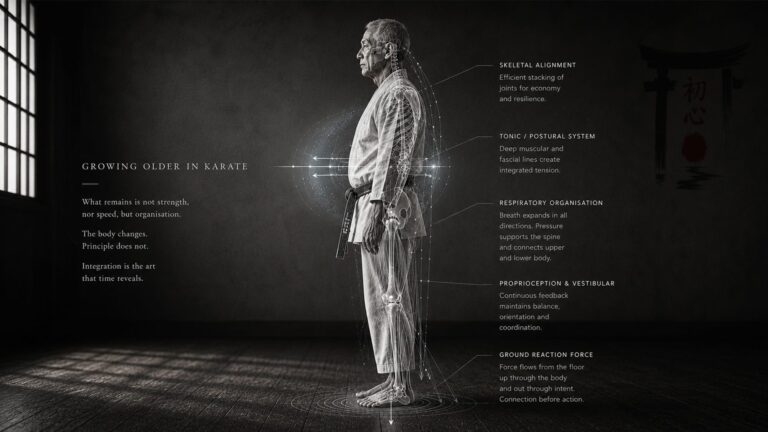
This is where the physical work behind the earlier articles becomes relevant. The body is a physical system. It operates within laws that do not change because we want them to: gravity remains gravity, force has to be transmitted through structure, balance cannot be negotiated, and the nervous system adapts to whatever we repeatedly ask of it. Age adds another constraint. Strength declines, recovery slows, mobility narrows, and the nervous system itself changes – so that compensations once hidden by physical reserve become easier to see. This is not an argument for abandoning physical training. It is precisely the opposite. The changing body gives the practitioner better information about the quality of the practice.
If technique depends upon unnecessary muscular effort, ageing eventually exposes that dependence. If structure is poor, reduced physical reserve makes the compensation harder to hide. If timing is dependent upon speed, declining speed reveals the dependency. If movement has become genuinely efficient, there may be less to lose.
Sensei Rokah, who trained with Nishiyama Sensei for twenty-seven years, offered a concrete example of exactly this: “Sensei Nishiyama, who is 80 years old, is not getting stronger, but the quality of his movement is constantly improving” [9]. Strength was no longer the variable in motion. Quality was.
Much of what I have written elsewhere about biomechanics and neurophysiology can be understood in this way. The body provides the conditions within which karate is practised, and those conditions are not negotiable. The older karateka simply has less physical reserve with which to conceal inefficiency.
Working only from biomechanics and neuroscience, I once put it this way: Budo is “the management of a closed physical system across a lifetime under the absolute, fixed laws of nature.” It is a useful summary of the physical argument. It is not, however, a definition of Budo.
Budo is broader than the management of the physical system. Nishiyama Sensei described the objective of Budo study as the development of the self regardless of physical strength, age or gender [7]. The physical system is therefore the condition in which the study takes place. It is not the whole subject of the study.
The Whole Practitioner
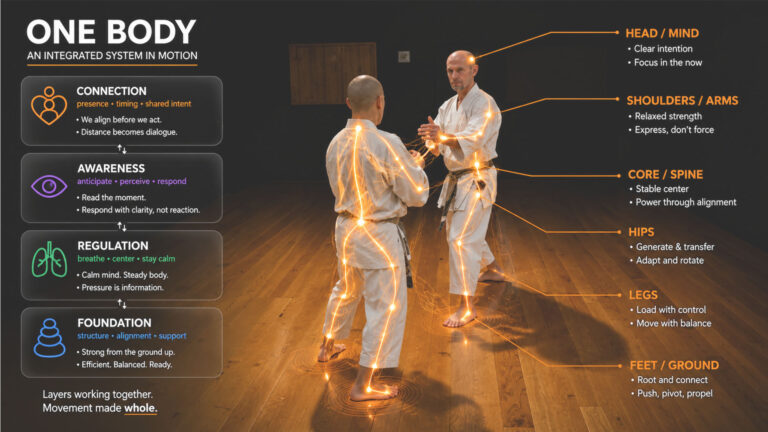
This was where the earlier articles eventually had to move beyond mechanics. Movement cannot be separated cleanly into muscles, connective tissue, nervous regulation and perception because the practitioner does not experience those systems separately. One Body made that argument directly. The same is true of Budo.
Nishiyama Sensei described Budo as involving both psychological and physical development, while the Traditional Karate material describes seriousness, humility, calmness, discipline and skilfulness as integrated parts of training rather than separate philosophical additions [10].
That matters enormously for an article about ageing. It means that ageing is not an awkward exception to the practice. It is one of the conditions under which the practice continues.
The older practitioner is not required to preserve the body of the younger practitioner. They are required to continue studying through the body they actually have. That changes the question.
Instead of asking only, “How much of my former ability can I retain?”, the practitioner can ask, “What does this body require from me now?” Sometimes the answer will be technical. Sometimes it will be psychological. Sometimes it will be uncomfortable. The body may reveal how much of who we thought we were rested on what we could once do.
The Mind in the Practice
This is where the traditional language of the mind becomes useful, but only if we resist turning it into another list of levels to reach.
Mushin is commonly translated as “no mind”. The useful point is not that the practitioner literally has no thoughts. It is that unnecessary conscious interference does not obstruct the action. The body has learned, and the practitioner does not have to narrate every part of the movement while doing it.
This is not simply modern psychological language dressed in Japanese. The failure it describes – a mind that catches and fixes on one thing instead of staying free – was named centuries ago. In the early seventeenth century, the Zen master Takuan wrote to the swordsman Yagyū Munenori about exactly this, in letters later collected as Fudōchi Shinmyōroku. Takuan’s teaching was that the mind must not stop anywhere. If attention fixes on the opponent’s sword, the freedom of one’s own movement is lost – “if your mind stops,” Takuan wrote, “you will be nothing but a corpse.” The mind he described was like water, moving freely through the whole body; the fixed, stopping mind was like ice – the same substance, frozen in one place and useless [11].
That matters technically, but it also says something about maturity in practice. The practitioner becomes less dependent upon conscious control without becoming less attentive.
Fudoshin, “immovable mind”, points towards another quality: stability when disturbed. Ageing supplies plenty of disturbance. The body changes. Someone younger becomes faster. A familiar technique no longer works in quite the same way. A capability that once seemed permanent disappears. The practitioner can become angry with the body, frightened by the loss, or attached to an identity that the body can no longer support. Or they can remain sufficiently steady to observe what is happening.
Nishiyama’s Budo material places seriousness, humility, calmness and discipline inside the training itself. Humility is necessary because once the practitioner believes they are better than others, learning stops. Calmness matters because pressure can disrupt judgement and physical response. These qualities are not decorations around technique. They are part of what the practice develops.
Will as Alignment
This brings us back to will. Will is not forcing the body to obey an outdated expectation. It is the willingness to align practice with reality. If the only reason I train is to win, then losing the ability to compete may remove the reason for training. If the only reason I train is to become stronger, declining strength may eventually remove the reason. If I train because the practice allows me to understand something about the body, the mind and their relationship, ageing changes the questions without exhausting them.
That does not make inquiry the superior motivation. It makes inquiry particularly relevant to persistence because it does not require the object of study to remain unchanged. The question changes.
At twenty-five, it may be: What can I make this body do?
At sixty: What can this body still do, and how efficiently?
At eighty: What is true about this body now?
Sensei Fusaro, after fifty years of training, put this simply: “After 50 years, I am still doing karate, and I am just as strong and fast as I ever was” [4]. It is a report from someone still finding the practice worth his full attention, five decades in. The practice is continuous. The practitioner is not.
What Remains
Persistence can sound like holding on – like gripping something tightly enough that it cannot be taken away. I do not think that is what it actually requires. Holding on suggests that the purpose is to preserve something exactly as it was, but a lifetime of karate makes that impossible. The body changes, the reasons for training change, the meaning of rank changes, competition changes, and understanding changes. The practice changes with the practitioner.
That is not a failure of persistence. It may be what persistence actually requires. Nishiyama Sensei described the objective of Budo as development of the self regardless of physical strength, age or gender. That is a very different proposition from preserving physical performance indefinitely.
The body remains the starting point. Martial technique remains the method. The Way gives that practice a purpose that cannot be exhausted by any single physical achievement. This is why the historical movement from jutsu towards dō matters to ageing. The martial technique did not disappear. It became the means through which something larger could be developed.
The body did not cease to matter. It became the place where the development was tested. And ageing does not end that process. It changes the conditions. The will to continue therefore does not have to mean wanting the same thing forever. It can mean being willing to meet a changing practice with a changing self.
The body will age, some things will disappear, other things may become clearer.
There is no peak because there is no final version of the practitioner waiting at the top.
There is only the practice, the changing body, and the willingness to keep looking.
Perhaps that is persistence in Karate-dō.
References
[1] Nishiyama, H. Interview by J. A. Pinheiro; seminar report by T. Ristimaki. “Hidetaka Nishiyama 1928-2008.” Shotokan Karate Magazine, Issue 99, April 2009.
[2] Deci, E. L., Koestner, R., & Ryan, R. M. (1999). A meta-analytic review of experiments examining the effects of extrinsic rewards on intrinsic motivation. Psychological Bulletin, 125(6), 627-668.
[3] Rokah, A. “Learning and Knowledge.” Avi Rokah Karate Blog, November 2011.
[4] Fusaro, R. “Karate for Life: An American Shotokan Pioneer.” Shotokan Karate Magazine, Issue 88, July 2006.
[5] Zimbardo, P. G., & Boyd, J. N. (1999). “Putting Time in Perspective: A Valid, Reliable Individual-Differences Metric.” Journal of Personality and Social Psychology, 77(6), 1271-1288.
[6] Carstensen, L. L., Isaacowitz, D. M., & Charles, S. T. (1999). “Taking Time Seriously: A Theory of Socioemotional Selectivity.” American Psychologist, 54(3), 165-181.
[7] Nishiyama, H. “BUDO Understanding – Definition and Fundamental Ideas.” Speech given at the inauguration of the Japan Budo-Martial Arts Council of the USA, Los Angeles, 11 December 2005.
[8] Funakoshi, G. Karate-dō: My Way of Life. Kodansha International.
[9] Rokah, A. “Less is More, Soft is Strong.” Shotokan Karate Magazine, Issue 96, July 2008.
[10] International Traditional Karate Federation. Traditional Karate: History and Definition.
[11] Lishka, D. (1978). “Zen and the Creative Process: The ‘Kendō-Zen’ Thought of the Rinzai Master Takuan.” Japanese Journal of Religious Studies, 5(2-3), 139-158. Takuan’s letters to Yagyū Munenori are collected in Fudōchi Shinmyōroku [Record of the Mysteries of Immovable Wisdom].
© Andrzej Czyrka / nyuanshin.com
This article may be shared, reprinted, or quoted for non-commercial purposes provided the author is credited and a link to the original article at nyuanshin.com is included. Commercial use requires prior written permission.