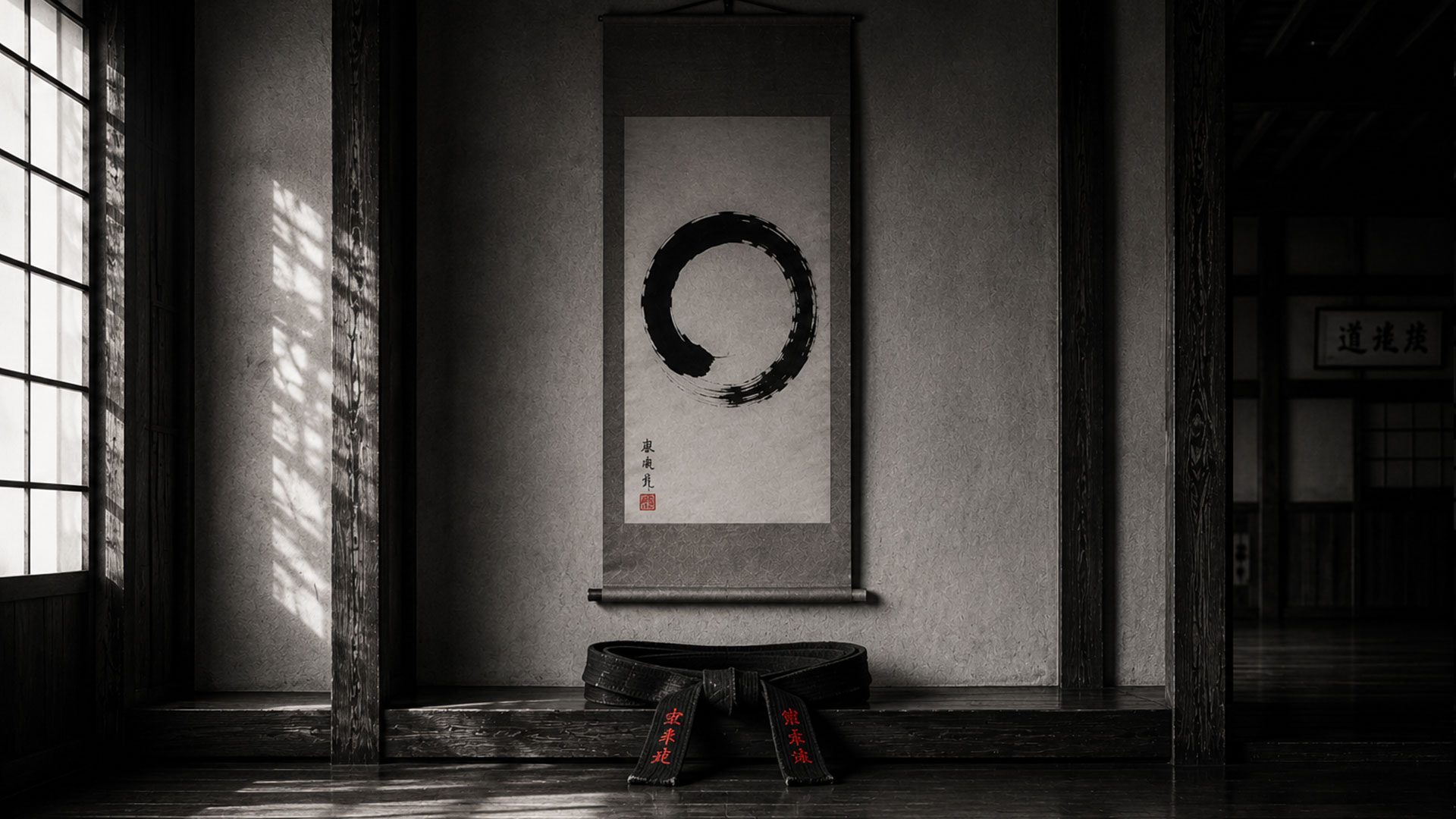
The Hidden Curriculum of the Dojo
There comes a moment in karate training when the physical noise quiets. The stances feel less like punishment and more like a place to rest. The hips know where to go without being told. And somewhere in that settling, a new set of demands emerges. The instructor stops correcting your knee position as much and starts checking your attitude (or “spirit” if you prefer) toward the training itself. You are asked to bow in a certain way, to breathe at a particular moment, to execute a technique with a quality of commitment that seems unnecessary for a combination you have done already hundreds of times. When you ask why, the answer is not about self-defence or fitness. The answer is something like: “It’s Budo.”
For most beginners, the word lands as an abstraction – a piece of Japanese terminology to memorise alongside kiba-dachi and oi-zuki. But Budo is not an abstraction. It is the operating system beneath traditional karate’s surface – the set of assumptions and purposes that transforms a collection of combat techniques into a lifelong discipline of human development. Without it, karate remains exactly what it appears to be: a physically demanding fighting method, impressive but ultimately limited. With it, every repetition, every bow, every moment of kime starts to make sense as part of something larger – one aimed not at defeating opponents but at refining the self. This essay traces that project.
Budo: The Foundation
The word ‘budō’ is composed of two characters: bu (martial) and dō (way, path). That second character is the same dō found in chadō (the way of tea), kadō (the way of flowers), and shodō (the way of calligraphy). It signals something specific: a discipline practised essentially not for its external product – the cup of tea, the arrangement, the brushstroke – but for what the practice itself does to the practitioner.
This distinction has deep roots. Japan’s combative traditions evolved over centuries from bujutsu – martial techniques developed for battlefield survival – into budō, ways of self-development through martial training. The historian Donn Draeger, whose three-volume study remains the standard Western reference, identified this as a fundamental shift in purpose: from systems designed to destroy enemies to systems designed to transform the practitioner. The techniques remained lethal in origin, but the goal moved from combat effectiveness alone to what the 1987 Budō Charter would later call “the perfect unity of mind and technique.” [1]
The Budo framework that shapes this understanding of traditional karate is, in historical terms, relatively young. Okinawan karate was a practical fighting art with no philosophical superstructure. The concepts of dō, Bushido, and Zen were mainland Japanese cultural elements, integrated into karate as it moved from Okinawa to Japan in the 1920s and 1930s. Oleg Benesch’s research has shown that Bushido itself was largely constructed during the Meiji era rather than inherited from the samurai. [9]
This does not weaken the framework. If anything, it strengthens the case: the methodology earns its place through what it produces on the floor, not through the age of its pedigree. What it cannot guarantee is that practitioners will take it seriously.
As early as 1976, Funakoshi’s senior student Egami Shigeru had already identified the drift: ‘The present situation is that the majority of followers of karate in overseas countries pursue karate only for its fighting techniques… It is extremely doubtful that those enthusiasts have come to a full understanding of karate-do.’ [10]
In 1987, after six years of deliberation involving representatives from judo, kendo, karate-dō, aikidō, and the other recognised martial arts, the Japanese Budō Association published the Budō Kenshō (Budo Charter) – a formal statement of what Budo is and what it demands. The preamble acknowledged a growing problem: that excessive concern with winning and technical showmanship was threatening the essence of budō itself. The Charter’s first article clearly defined the objective: through physical and mental training in the martial arts, practitioners seek to build character, sharpen judgment, and become disciplined individuals capable of contributing to society. Its second article warned against pursuing “mere technical skill” at the expense of the unity of mind, body, and technique. [2]
This was not a single school’s opinion – it was the institutional voice of a tradition speaking about itself. And it was responding to exactly the drift that Nishiyama Sensei had been fighting against for decades.
Gichin Funakoshi, the founder of Shotokan karate and Nishiyama Sensei’s teacher, had laid this groundwork for karate specifically. His Niju Kun – twenty precepts for karate practice – drew heavily on Bushidō and Zen. “Spirit before technique.” “Karate goes beyond the dojo.” “Apply karate in everything; therein lies its beauty.” “Karate is like boiling water; if you do not constantly heat it, it returns to its tepid state.” Each precept was deliberately concise, designed not as instruction to be followed mechanically but as a provocation to be explored over a lifetime. They established that karate-dō – karate as a way – was inseparable from character development, discipline, and a particular quality of seriousness in training. [3]
This is the tradition Nishiyama Sensei inherited. And he took it somewhere specific.
In a 2005 speech on Budo principles, Nishiyama Sensei stated: “Budo practice enhances a person’s mental strength, scale and class in a manner that potentially enables practitioners to control an opponent without physical confrontation. Budo is the foundation of physical disciplines that pursue victory without fighting.” [4] Where the Budō Charter spoke in institutional language about character building and social contribution, Nishiyama Sensei drove straight to the paradox at Budo’s heart: you train to fight so completely that fighting becomes unnecessary. Not because you avoid confrontation, but because your capability – your presence, your structure, your movement quality – changes what is possible in an encounter.
Sensei Rokah cuts to the operational reality in his writing on the Budo aspect of karate: the original function of karate was to destroy an opponent’s offensive power and protect oneself, and you cannot bypass that function to reach the mental and spiritual dimensions beyond it. “It is only through being at the edge, training as if ‘one chance live or die,’ that one can truly experience the mental/spiritual understanding through karate.” [5] And as he observed directly from Nishiyama Sensei’s teaching: “Training mindlessly would just strengthen bad habits and bring stagnation.” [7]
To classify traditional karate as another form of physical exercise is to view it as sport, and that misses the point entirely. This is not anti-sport sentiment. Both Nishiyama Sensei and Sensei Rokah competed and coached competitors at the highest levels. The point is more precise than that: sport training, by its nature, allows trade-offs. You can prioritise speed over structure, timing over power, because the rules protect you from the consequences of compromised technique. Budo training does not permit these trade-offs. When you train as if the technique must stop the opponent – as if your life depends on it – you cannot fool yourself about whether it works. The floor, the makiwara, the partner’s body all give you honest feedback. Every sloppy repetition embeds a pattern that will fail under real pressure. Every correct one builds something that holds.
That is why Nishiyama Sensei refused sloppiness, demanded dignity and good manners, wanted his students to be sincere and pure in their training, and asked them to execute each technique as if it were their only chance. “Karate is fighting with dignity, like a samurai, not like Yakuza.” [6] The etiquette, the bowing, the attention to small details – these were not cultural decoration added to the physical training. They were the training, experienced through everything from how you tie your belt to how you breathe at the moment of kime.
This Budo foundation shaped everything Nishiyama Sensei taught – the insistence on fundamentals, the refusal to compromise on proper form, the emphasis on developing capability that goes beyond physical technique. He wasn’t teaching karate as a fighting system alone; he was transmitting a methodology for human development that used karate as its vehicle. “Best fight is no fight,” he would say. “Keep trying.” “Target is self.” [6]
The Practical Philosopher
There’s something unusual about how Nishiyama Sensei taught. He was intensely practical – you could watch him demonstrate a technique and see immediately that it worked, that it was efficient, that there was no wasted motion or energy. But he was also deeply philosophical. He didn’t lecture about concepts or spend training time discussing ideas. The philosophy was embedded in how he taught, in what he insisted upon, in the details he refused to compromise on.
Sensei Rokah describes him as being ‘very pragmatic and a philosopher at the same time.’ You can read about Budo principles and understand them intellectually, but you cannot understand how the technique works without training. And you cannot embody the philosophy – make it part of how you move and respond – without thousands of repetitions that teach the body what the mind can only describe. [6]
Nishiyama Sensei had a gift for distilling complex ideas into simple statements that carried multiple layers of meaning. ‘Keep trying’ was how he summarised his philosophy – not particularly profound on the surface but consider what it means. Not ‘try harder’ or ‘never give up’ or any of the other motivational slogans people use. Keep trying. This wasn’t just about effort – it was about maintaining the right mindset. Once you think you know, you’re finished.
Sensei Rokah tells a story about when Nishiyama Sensei came to visit his dojo, and a student in the children’s class dropped their belt on the floor. Nishiyama Sensei was deeply bothered – not in a momentary way that passed quickly, but persistently. He kept bringing it up for months afterwards. At first, Sensei Rokah didn’t understand why something so small warranted such attention. But the reason became clear over time: training occupies only a few hours of your day (at best). The rest of your life is much longer. If awareness collapses over something as simple as a belt, it will collapse under pressure. The small details outside the dojo directly shape how precise you can be within it. [6]
This ran through everything Nishiyama Sensei taught. ‘Don’t do it the convenient way, do it the right way’ – which sounds simple until you realise he’s talking about a fundamental choice in how you approach training and life. The convenient way creates habits that eventually limit you. The right way might be harder initially, might take longer to learn, might feel awkward or inefficient at first. But it builds a foundation that keeps working as you progress, rather than a ceiling you hit once the easy gains run out.
As Sensei Rokah observed of Nishiyama’s karate: “Without understanding the complexity one could not reach a skilful simplicity.” [7]
Kuchi-Waza and Embodied Wisdom
There’s a Japanese term ‘kuchi-waza’ that translates roughly as ‘mouth technique’ — talking about karate rather than doing it. Nishiyama Sensei used a few words in his teaching, but each word carried maximum meaning because it was connected directly to physical demonstration and practice. He wasn’t interested in abstract discussions about technique; he wanted students to feel the difference between correct and incorrect movement, to understand through their own bodies rather than through intellectual analysis.
This is harder than it sounds. Most of us are trained to understand things conceptually first, then try to apply them. This isn’t wrong – conceptual understanding can guide the body in the right direction. But it can’t do the body’s work. The understanding that matters in karate must come through movement, through repetition and refinement and careful attention to what happens when you move in different ways. Concepts can point; only the body can arrive.
Sensei Rokah tells the story of when he first came to Los Angeles in 1981, expecting hard training and spiritual karate. After his first class – the Friday noon class – Nishiyama Sensei told him: ‘Put white belt on, step by step, understand?’ Sensei Rokah already had a black belt from another school, had years of training, and thought he understood karate. But Nishiyama Sensei watched him move and saw that the foundation he had would eventually limit him. Better to rebuild from the beginning than to continue developing on top of flawed basics. Seven months of white belt training, starting over, relearning techniques he thought he already knew. It’s uncomfortable to admit you need to go back to fundamentals, especially after you’ve invested years in training. But that discomfort is exactly the point – it reveals where you’ve been fooling yourself, where you’ve substituted the appearance of skill for the actual thing. [6]
Todome
Todome is the Japanese word for a finishing blow – the technique that ends the encounter decisively. In his 2005 speech on Budo principles, Nishiyama Sensei stated clearly: “In a Budo match, every unnecessary condition and technique should be eliminated because all Budo systems were originally developed to beat an opponent as quickly as possible… The final goal is to destroy an opponent’s power with one ultimate move.” [4]
It’s about completeness – the demand that every technique carry sufficient structure, power, and commitment to finish what it was launched to do. A technique without todome intent is a gesture. It may score a point, but it resolves nothing.
Training with todome in mind means you can’t fool yourself about whether a technique works. You can’t pretend that a weak punch with good timing is the same as a properly executed technique. You can’t substitute athleticism for technical precision. When your technique fails because your structure collapsed under pressure, you don’t need a lecture on integrity; you’ve just experienced physically what integrity means and what happens when you compromise it. The floor teaches you the philosophy through your body’s direct encounter with reality (the floor doesn’t care about your intentions or your explanations – it only responds to force applied with proper structure and timing).
Traditional vs. Stagnant
‘Traditional’ is one of the most misread words in karate. It’s taken to mean doing things the way they’ve always been done, preserving forms and methods unchanged, valuing history over effectiveness.
Traditional karate (properly understood) is traditional precisely because it continues to work, because it’s been refined and tested over generations, because it represents solutions to fundamental problems of human movement and power generation that don’t change just because technology advances or cultural contexts shift. The principles are traditional; the application of those principles must adapt to each individual body, each training environment, each moment of practice.
Nishiyama Sensei merged Okinawan karate with Japanese Budo philosophy and sport science. He wasn’t a purist refusing to learn from other sources – he was deeply interested in how scientific understanding of biomechanics could illuminate and improve traditional techniques. His teaching was methodical and scientific – every detail had a reason, had to work, and had to be part of the whole picture. But he also understood that science describes effects without necessarily explaining causes, that measuring something doesn’t mean you understand it, that there are layers of knowledge in traditional training methods that modern analysis hasn’t yet reached.
A Distinctive Approach
Nishiyama Sensei inherited Funakoshi’s philosophical foundation – the precepts, the emphasis on character through disciplined practice, the dojo culture where kata dominated the training. But rather than preserving these methods unchanged, he asked a different question: how could the philosophical principles be understood through the lens of modern science – through physics, physiology, biomechanics, body dynamics?
This was the 1960s and 1970s, decades before sports biomechanics became sophisticated, before motion capture analysis, before much of the research that would later validate what he was teaching. He worked from direct observation and systematic experimentation, integrating concepts from physics and physiology into traditional training methods in ways genuinely ahead of his time.
The discovery was that traditional methods, when examined carefully, embodied principles that science could describe and validate. The philosophy wasn’t separate from the physics; the philosophy was the physics, expressed through the human body moving efficiently under real constraints.
This created a distinctive approach within traditional karate. Where Funakoshi emphasised character development through disciplined practice of forms, Nishiyama Sensei emphasised understanding why the forms work as they do, what principles make a technique effective, and how force is generated and transferred through proper structure and timing. He was very practical – everything had to work, be testable, and fit the integrated whole. But he remained deeply philosophical, insisting that training develops something beyond just physical capability.
Sensei Rokah inherited this approach and added something crucial to it through his years of documentation and teaching. Where Nishiyama Sensei taught primarily through demonstration and minimal verbal instruction, Sensei Rokah worked to make the implicit explicit – to articulate the principles that Nishiyama Sensei embodied but rarely explained in words. Consider Aiko San: Nishiyama Sensei’s secretary, a woman with a dance background who never formally trained in karate, yet who could correct a black belt’s technique by listening to the sound of his breath. Her understanding of movement, timing, and energy was extraordinary – and entirely oral. None of it was written down. Without Sensei Rokah’s documentation of what she taught him – her insights would have disappeared entirely when she was no longer there to offer them.
This documentation work is crucial because much of traditional martial arts knowledge is lost precisely at this transition point. The first generation learns through direct experience under a master. The second generation has some direct experience but less exposure. The third generation often has only forms and fragments, having lost the understanding of why things are done a particular way. By documenting the methodology systematically while remaining true to the experiential foundation, Sensei Rokah created a bridge between direct transmission and articulated knowledge.
The result is an approach that insists philosophy must be grounded in physics and tested against reality – that traditional methods contain wisdom science can validate but not replace. Every detail matters because every detail either supports or undermines the whole, and convenient shortcuts now create ceilings that no amount of effort can break through later.
How Philosophy Becomes Physical
How exactly does philosophical principle become physical reality? It’s one thing to say philosophy and practice are integrated; it’s another to show concretely how that works.
The answer lies in understanding that what we call ‘philosophy’ in this context isn’t abstract speculation but practical wisdom about training – how to approach difficulty, maintain standards, and investigate your own movement. This wisdom manifests physically through training choices that either build proper patterns or embed compensatory ones.
The distinction between deliberate practice and mere repetition is the key. You can repeat a movement ten thousand times and build strong neural pathways – but if the movement is wrong, you’ve just made the wrong pattern very difficult to change. The body doesn’t distinguish between correct and incorrect; it just reinforces whatever you practise consistently.
Nishiyama Sensei’s insistence on doing things ‘the right way’ rather than ‘the convenient way’ manifests in specific training choices. The right way means maintaining proper posture throughout a technique, even though letting your head drift forward, or your spine compress, would feel easier. It means training the full range of motion, even though you could get away with partial movements. It means keeping a proper connection between the upper and lower body, even though you could generate some power through purely arm strength.
When you choose the convenient way, you’re training your nervous system to accept poor quality, to settle for approximate rather than precise, to prioritise immediate comfort over long-term capability. Every repetition either reinforces proper patterns or embeds compensatory ones. The brain builds different neural pathways depending on what you practise. Quality matters more than quantity because the wrong movement, repeated a thousand times, doesn’t magically become right. It becomes deeply wired into your nervous system, making the correct movement harder to access later.
Nishiyama Sensei articulated one key principle explicitly in his systematic documentation: “If there is no external force, one cannot increase energy. Also, one cannot shift centre of gravity. External force is reaction force using internal force (one’s own body power) and giving pressure to a stationary object (like floor, ground, wall, etc.).” [8]
This is where philosophy meets physics in a single sentence. You cannot generate force in isolation. Your body needs something to push against – the floor, the ground – and proper structure is what allows the reaction force to transmit cleanly through the body rather than dissipating as tension and compensation. The principle is simple; the application is a lifetime’s work.
References
[1] Draeger, D.F., Classical Budo: The Martial Arts and Ways of Japan, Vol. II, Weatherhill, 1973
[2] Japanese Budō Association, Budō Charter (Budō Kenshō), 1987
[3] Funakoshi, G., Niju Kun (Twenty Precepts), published in Nakasone, G., Karate-do Taikan, 1938
[4] Nishiyama, H., Speech on Budo Principles, 2005
[5] Rokah, A., “Budo Aspect for Gaining Karate True Value,” avirokahkarate.blogspot.com, 2012
[6] Rokah, A., “Sensei Nishiyama the Practical and the Philosopher,” avirokahkarate.blogspot.com, 2013
[7] Rokah, A., “Nishiyama: My Sensei,” Shotokan Karate Magazine, Issue 99, April 2009
[8] Nishiyama, H., Traditional Karate Coach’s Manual, International Traditional Karate Federation, 1989
[9] Benesch, O., Inventing the Way of the Samurai: Nationalism, Internationalism, and Bushido in Modern Japan, Oxford University Press, 2014
[10] Egami, S., The Heart of Karate-Do, Kodansha International, 1976
© Andrzej Czyrka / nyuanshin.com
This article may be shared, reprinted, or quoted for non-commercial purposes provided the author is credited and a link to the original article at nyuanshin.com is included. Commercial use requires prior written permission.
Leave a Reply