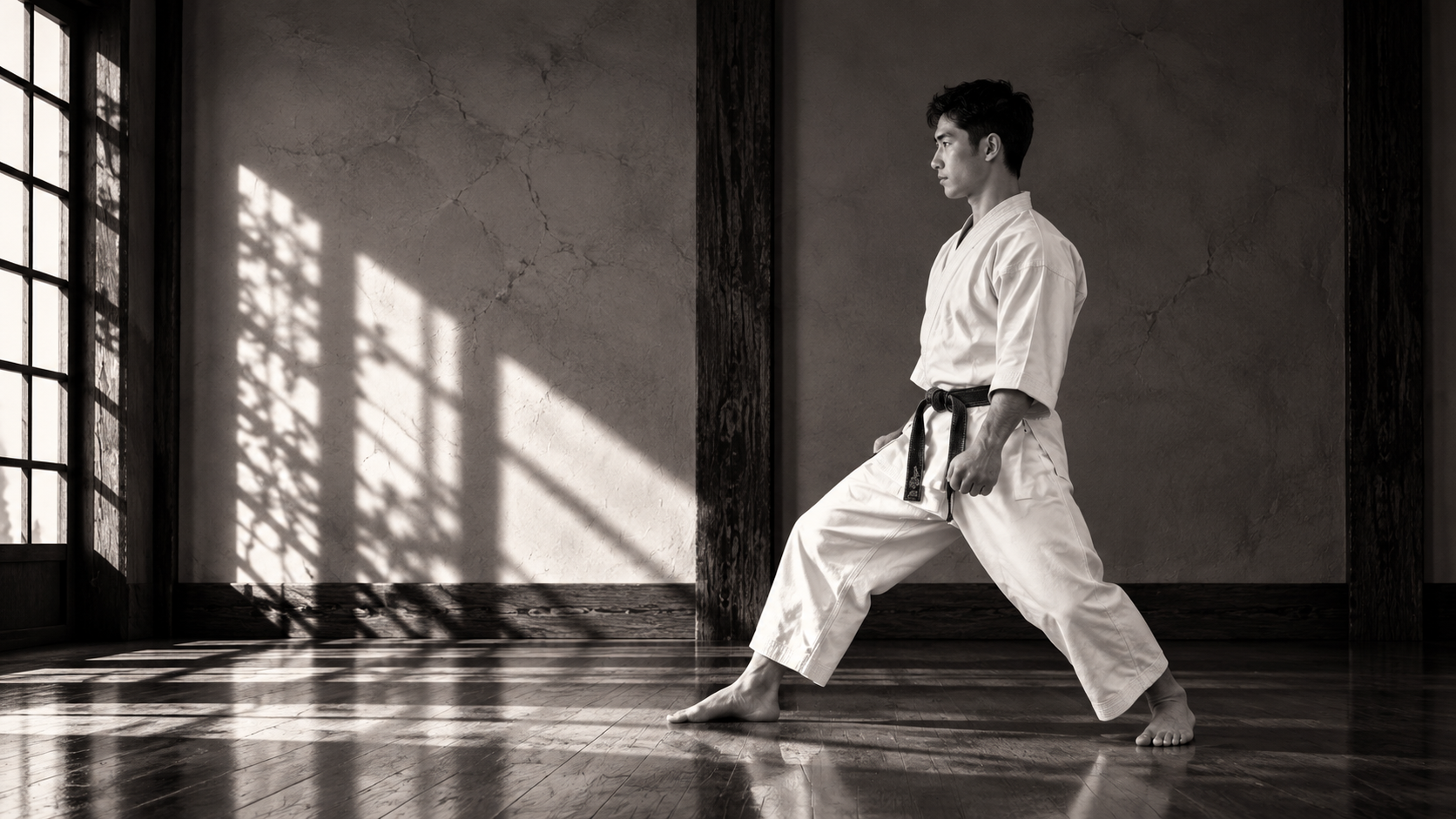
Stances get taught as shapes to copy – each with specific depth, angle, weight distribution – and rarely as answers to a question: what problem does each shape solve, and when does it stop being the shape you need?
The previous article in this series, Posture: The Blueprint of Potential, drew the distinction plainly: posture is the set of mechanical conditions the body must satisfy regardless of shape, while a stance is posture made specific – a particular configuration adopted to solve a particular problem. This piece turns to the stances themselves – the specific shapes karate names, drills and passes down.
What a stance is
A stance can be defined as a temporary organisation of the feet, legs, pelvis and centre that allows the body to interact with the ground in a particular way. It determines where the centre of gravity is placed, how force can be directed into and received from the floor, how the body is aligned, and what movement remains available. The stance exists to solve a mechanical problem; its shape follows from the solution. The important word here is temporary.
Nishiyama Sensei’s Traditional Karate Coach’s Manual places stance among the Foundational Techniques of karate, opening with kamae (the readiness stance, and a stance in its own right). From kamae, the practitioner should be able to move quickly backwards and forwards, drive forward, and transition smoothly into the next technique – in other words, stance is part of a movement system. Body shifting, sliding, stepping and shuffling sit alongside stance as Operational Techniques; Foundational and Operational Techniques both feed directly into offence and defence. [1]
Using a stance to organise the body for movement is not unique to karate, even though it is easy to train for years and quietly assume it is. Any discipline that has to move a body from the ground up faces the same problem stance solves – directing force into and out of the floor while staying ready to move – and every skilled physical discipline has arrived at its own solutions.
A boxer’s stance gives balance, mobility, protection, and the ability to initiate movement without unnecessary preparation. A tennis player uses a ready position and split-step to stay ready to move in any direction. Research on the tennis split-step shows that it can substantially shorten the time required to initiate movement, largely by allowing force production to begin sooner. [2]
A fencer’s on-guard position provides an organised starting point from which the lunge can be initiated explosively; biomechanics research shows that lower-limb coordination, foot placement and the position of the body in the on-guard stance all influence lunge performance. [3]
A sprinter’s set position varies by athlete – sprint research finds no single universally optimal configuration – because what matters is how effectively the position lets force be produced against the blocks and acceleration begin. [4]
A weightlifter catching the bar at the shoulders drops instantly into a deep squat, using the stance to absorb and control a sudden, heavy load.
They arrived at similar answers because the body and the physics are the same. Karate names, isolates and drills these configurations as training tools in their own right. The shape is not the principle. The shape is one way of learning the principle.
Outside tension / Inside tension
Nishiyama Sensei classified stances through the direction of muscular tension in the legs and groin.
Outside-tension stances include zenkutsu-dachi, kiba-dachi, kokutsu-dachi, sochin-dachi and shiko-dachi. The manual describes the muscular action as twisting from the inside toward the outside and says that this configuration is particularly strong against sudden shock.
Inside-tension stances include neko-ashi-dachi, sanchin-dachi and hangetsu-dachi. Here the twisting tension is directed from outside to inside, and the manual describes these stances as enabling sudden movement in any direction after execution of a technique. [1]
The classification is functional. Two stances that look different can be understood through the same mechanical question: how is the musculature organising itself around the centre, and what does that organisation allow the practitioner to do?
Sensei Rokah is specific about what that organising involves: the bones themselves do not move. The thighbones stay in place; it is the muscles that contract around them, tightening toward or away from the centreline. If the bones move instead – if the legs rotate rather than the muscles simply tensing – the thighbones fall out of proper alignment with the hip sockets, energy transfer at the hip is incomplete, and the joint absorbs stress it was never built to carry. Over years, that kind of misalignment is a plausible route to injury in its own right, at the hip rather than the knee. [5]
He adds another useful distinction: kime stance – the stance at the moment of impact – versus kamae stance, the stance of readiness. [5] They describe different functional states.
Kamae is often described as readiness, but that word hides what the body is doing: it doesn’t “wait,” and it doesn’t “rest.” Sports science has a name for what a held ready position accomplishes: neuromuscular pre-activation. A tennis or badminton player’s split-step is the clearest studied example – landing back into a loaded stance with the leg muscles already pre-tensioned ahead of contact, rather than tensing only once contact begins, which measurably shortens the time to the next explosive movement compared with reacting from a passive stance. [2] The same mechanism improves footwork efficiency and reduces injury risk more generally. [6] It’s the one karateka rely on without naming it: a muscle already under some tension responds faster than one starting from zero, because force does not appear the instant a nerve signal arrives – there is a real, measurable lag between activation and force production, and pre-activation is what shortens it. A kamae held with the muscles switched off is not ready in any sense that matters; it has the shape of readiness. Readiness is the low-level tension underneath the shape – the thing a photograph cannot show you.
A punch driving into a target and a hard block stopping an incoming strike are doing opposite things – delivering force, receiving it – but both generate a reaction pushing back against the practitioner. For either, kime requires strong contact with the floor, a low centre of gravity, and enough structure to resist that recoil while transmitting force. [1] A deflecting technique such as nagashi-uke asks something different of the stance. The hand and arm do the redirecting – moving with the incoming attack rather than stopping it – while the stance’s job is separate: supporting the body and setting up the counter that follows. Because the arm is not absorbing a head-on force, the stance underneath it does not need the same low, planted base a stopping technique requires.
Kicks are still delivered with kime, but the body organisation is different, and it varies from kick to kick. The supporting leg now carries what both legs used to share, and how it does so depends on the technique: some kicks load it in a fairly straight line, others ask it to pivot and generate rotation. Where a kick does pivot the support leg, the same turn that produces a stronger kick also loads the knee with rotational stress – the ACL, the anterior cruciate ligament and one of the main stabilisers holding the knee together, is put under exactly this kind of strain, and it is one of the most commonly injured ligaments in the knee. [7] The same mechanism is covered again later in this piece for a locked rear leg in zenkutsu-dachi, here carried by one leg instead of two. [8] Different kicks make different demands on the base. What stays constant is that the base still has to hold.
Nishiyama Sensei’s own teaching treats stance and footwork as one continuous subject, not two separate topics. At a 2007 seminar in Edinburgh, he built an entire session around footwork: yori-ashi, okuri-ashi, tsuri-ashi, hiraki-ashi, mawashi-ashi – a full vocabulary of named steps, each with its own mechanical logic. Okuri-ashi, the basic sliding step, keeps the weight centred while driving in whichever direction you push. Tsuri-ashi draws the back leg into a cross-over position to cover more distance while the centre stays on a level plane. Hiraki-ashi opens sideways into kiba-dachi without shifting weight from one foot to the other – the feet open first, and the centre follows. [9][10] Sensei Rokah describes kime and footwork as two sides of the same coin: kime is the ability to deliver force, while footwork is the ability to change position and distance, initiate technique and respond without unnecessary preparation. [11]
Stance, footwork, and the structural demands of kime – kihon teaches all of it with precision. Sensei Rokah holds stance to a strict standard in kihon and kata: the rear heel stays firmly on the floor, the ideal that kata and basics are built to show, departed from only for genuine injury. [12] The reason is mechanical: heel down connects the rear leg fully to the body centre, letting the pressure generated at kime cycle unbroken from foot to centre and back, instead of escaping through a floating heel. [12]
The same precision runs through the whole stance. Kihon conditions the body across its full range, moving through several stances within a single sequence – a shuto-uke block in kokutsu-dachi, say, followed by kizami-mae-geri and nukite in zenkutsu-dachi – each shape held and drilled at its full depth. Sensei Rokah’s reasoning is that the large range has to come first, because training through it builds a capacity a smaller range never develops on its own. [13]
Jiyu kumite asks something different of the same precision. Kamae is always personal and situational, in kata as much as anywhere else. What kumite changes is what shapes it: a live opponent, through maai (its own subject elsewhere in this series), rather than a kata’s fixed sequence. Kime stance is dictated by whatever technique the moment produces. Sensei Rokah states the relationship directly: in kumite one may depart from the form learned in kihon and kata, provided its underlying principles are not violated. [12] Some black belts with excellent kata struggle in kumite because they try to apply the kihon technique itself, rigidly, rather than the principle it was teaching. [13]
No one performs age-uke or gedan-barai in real sparring the way it is drilled in the basics. Form is the vehicle: strict while the body is still learning what the shape is for, loosened once the principle underneath it has been absorbed. [14] The precision of kihon is how the fluidity of kumite becomes possible.
The shape is the record of a movement, not the movement itself. You end up in neko-ashi-dachi because your weight has shifted in a particular way and the front leg has become available for something else. You arrive in zenkutsu-dachi because the body has organised itself to transmit force in a particular direction. If we forget the movement that produced the shape, we can become very good at reproducing the photograph and very poor at reproducing the movement.
Weight-distribution figures are often quoted as though they were the whole story – the Coach’s Manual and other technical texts give ratios for each stance, and those figures are accurate as far as they go. Sensei Rokah draws a sharper distinction underneath them: in nearly every stance, the weight itself stays at the centre. What shifts toward one leg or the other is pressure, driven by breath moving through the body centre, not a fixed percentage split. [15] In zenkutsu-dachi the pressure moves toward the front foot; in kokutsu-dachi, toward the back. The stance’s form is close to meaningless without that active interaction between both feet, the centre and the breath – it is what turns a static ratio into what Sensei Rokah calls a coiled spring.
The danger of parking
And static holding may itself be a consequence of the lost understanding. If you understand a position as a moment in a transition – a snapshot of movement – you pass through it. If you understand it as a stance to adopt and hold, you park in it. That does not mean that static stance training has no value. It clearly has. Sanchin, for example, may deliberately use sustained contraction and controlled breathing as a training method. But that is a different exercise from using a stance as the mechanical state through which technique is transmitted.
Nishiyama Sensei’s point about kime concerns duration: “there is no such thing as a focus lasting for any measurable length of time.” [16] The kime stance concept addresses a different question about the same instant – not how long it lasts, but what shape the body must hold to transfer or absorb force while it does. [5]
Nishiyama Sensei’s own requirements at kime – already set out above – describe an active relationship with the floor. The same principle appears differently in Sensei Rokah’s own writing. At kime, pressure into the floor and total-body contraction create the conditions for force transfer; immediately afterwards, the practitioner must be able to move again. Strong kime and fluid transitions are not opposites. Proper kime should be the best condition from which to begin the next technique. [5] Outside stops. Inside does not stop. The photograph freezes. The body does not.
What the deep stances actually do
Neko-ashi, sanchin, hangetsu in their full depth? Difficult to hold, uncomfortable on the knees, rarely seen outside kata. The honest question: what are they for? I can offer four possible answers.
First – the postural system
A deep stance does something that an explosive technique does not: it asks the body to sustain force while apparently doing nothing.
Postural muscles are specialised for this kind of work. The human soleus, for example, is dominated by fatigue-resistant type-I fibres and contributes continuously to maintaining the body’s centre of mass during upright stance. [17] More generally, sustained low-level muscular activity depends heavily on oxidative metabolism and on a continuous supply and regeneration of ATP (adenosine triphosphate – the molecule muscle cells burn to contract; without a steady resupply of it, a muscle simply stops working). What makes a deep stance demanding is functional, not categorical: the body is being asked to maintain a mechanically demanding configuration rather than simply produce a brief burst of force. Research on isometric training shows that repeated sustained contractions can produce genuine long-term adaptations – morphological, neurological and performance-related – and that the adaptations depend partly on the muscle length and intensity at which the training is performed. [18]
There is also direct evidence that endurance training can alter the muscle’s capacity to produce ATP aerobically. In one human study, six weeks of endurance training increased mitochondrial ATP-production rate and mitochondrial enzyme activity in skeletal muscle. [19] This gives us another way of understanding traditional stance training. Its purpose need not be reduced to making the legs stronger. Repeatedly entering and maintaining demanding positions trains the body’s ability to sustain coordinated postural work while controlling alignment and force. Over years, that may contribute to one of the least visible differences between a beginner and an experienced practitioner: the experienced practitioner does not merely have the strength to occupy the position. The position costs less.
That last sentence is an inference, rather than a demonstrated karate-specific finding. But it is a physiologically plausible one. And practitioners recognise the reverse experience too. After illness, poor sleep or prolonged stress, a familiar stance can suddenly feel heavier. Fatigue and altered neuromuscular control can affect the ability to sustain posture economically, even where the underlying mechanism is not fully mapped. The stance may look exactly the same from the outside while its physiological cost has changed.
Second – proprioceptive training at the extremes of range
The traditional stances also expose the nervous system to joint positions and loads that ordinary everyday movement may rarely explore. The anatomy is more complicated than the popular explanation sometimes suggests – human ankle ligaments contain several distinct classes of mechanoreceptors, not one. [20] In the broader sense, proprioception is not generated by one magical sensor. It emerges from information coming from muscles, tendons, joint structures, ligaments and the skin, all contributing to our sense of position and movement. Deep stance training therefore gives the nervous system information about positions, loads and relationships that may not be encountered very often in ordinary movement. The discomfort is not necessarily evidence that the position is wrong. But neither is discomfort proof that the position is beneficial. The value lies in controlled exposure, not simply in going deeper.
Third – the nervous-system argument
Sensei Rokah’s explanation is particularly clear: “The big includes the small but not vice versa.” [15] Training through a large range teaches the nervous system to coordinate the kinetic chain through that range; once the larger movement is understood, smaller movements within it become accessible. This makes sense of something that can otherwise look absurd to a modern observer:
Why spend years practising a range of movement that is larger than the one normally used in application?
Because kihon is not intended simply to reproduce the range of application. It is a training environment in which the practitioner can exaggerate the movement, feel the relationships between the segments, receive feedback and gradually internalise the coordination. Large-range practice builds that coordination once; application can then draw on it at whatever range the moment requires. [15]
Fourth – resilience
Sensei Rokah also argues that training at end ranges can condition both tissue and the nervous system to deal with situations in which technique goes wrong or the body is forced toward its limits. [15] The comparison is a straightforward one: a body trained near its end ranges and one that has never been asked to go there will not fail at the same point, or in the same way, when a technique goes wrong. I would phrase the broader claim more cautiously. Full-range training can develop strength, coordination and control in positions that would otherwise remain unfamiliar. But range has to be trained with control; alignment, load, progression and individual anatomy all matter. Push past what the tissue can currently handle, and the same extreme range that builds resilience becomes the injury itself. The value of the deep stance lies in the training deliberately exposing the practitioner to a larger movement vocabulary than everyday movement would normally require.
The stance that shortens
Any honest account of deep stances has to confront the knee and hip damage that affects long-term karateka. The Poznań University study gives us a useful piece of evidence. Researchers measured ground-reaction forces in fifteen experienced Shotokan kata athletes during transitions involving zenkutsu-dachi, kokutsu-dachi and kiba-dachi, finding vertical forces exceeding three times body weight and particularly high anteroposterior forces in kiba-dachi – forces the authors specifically identify as making it the most dangerous of the three stances. The same athletes showed lower limb muscle contractures, especially in the hip abductors. [21] What the study establishes is that these apparently simple movements generate very large ground-reaction forces, with loading patterns differing substantially between stances – not that the stances themselves, rather than the transitions between them, are the cause. What it tells us is that the mechanical details of how we enter, occupy and leave a stance matter.
The hips carry a cost of their own. A study of Polish national-team kata athletes found that kata stances and their movement pattern were linked to measurable disturbances in hip internal and external rotation range of motion, alongside changes in pelvic tilt and lumbar spine position. [22] That is consistent with the hip abductor contractures the Poznań athletes already showed above. [21] Both point to a pattern worth taking seriously.
Depth is not free, and it is worth being precise about what it costs rather than treating lower as though it were stronger without limit. Against a static load – an opponent trying to break your posture – a lower centre of gravity genuinely is an advantage with no ceiling other than how long the legs can sustain it: the deeper you sit, the shorter the lever an opponent has to work with. Producing force to drive forward is a different problem, because it now involves time as well as strength. Research into jump mechanics shows depth trading against itself: a deeper knee bend gives the muscles more distance and more time to apply force, which can increase total impulse, but it also reduces the force and power the muscles can generate at that joint angle, partly because the leverage the patellar tendon has on the knee measurably shortens as the knee flexes further. [23][24] Neither extreme wins outright, and the research consistently finds that a self-selected, moderate depth tends to perform as well as or better than either extreme. [25] This is the practical difference between a stance built to hold and a stance built to launch from: one wants as low as the legs can sustain, the other wants only as deep as the joint can still produce force efficiently, and no deeper.
A related 2021 study compared conventional walking with traditional zenkutsu-dachi stepping, finding the karate version considerably more energetically demanding – the result of higher muscular moments of force and a failure to convert potential energy into kinetic energy the way ordinary walking does. [26] Traditional karate stepping is mechanically expensive by design, which makes the quality of the movement, not just its depth, worth examining closely.
One specific habit deserves that scrutiny: whether the rear knee in zenkutsu-dachi locks straight or stays slightly bent. Sensei Fusaro recalled being taught, decades ago, to lock it – “Straighten your back leg out!… if you didn’t, they’d walk up it and your knee would smash into the floor” – and named it himself as exactly the unexplained, blunt-force teaching he is glad has passed. [27] The mechanics agree with him. A fully extended knee has measurably less capacity to absorb and return force than one flexed even slightly, [28] and strain on the ACL – already discussed for kicks – peaks specifically near full extension under rotational load: exactly the kind of loading zenkutsu-dachi transitions generate. [29] A motion-capture study tested this directly, comparing zenkutsu-dachi movement patterns in karate athletes. Bending the rear knee slightly, combined with bringing the front leg further forward, produced significantly greater angular velocity in the hip joint than the straighter-leg patterns tested. [30] A rear knee held with a small, deliberate bend – a suspension, not a lock – stays part of the coiled spring rather than outside it. The front knee carries a version of the same risk. Its motion should stay in one plane, straight forward and back in line with the foot; the moment it drifts sideways under load, injury follows quickly. The same rule applies to the rear knee, whichever direction its own foot points.
Several senior Shotokan teachers changed their own stances as they aged, in both depth and lock. Nakayama Sensei used a considerably shorter zenkutsu-dachi later in his career than his own 1966 book, Dynamic Karate, is often remembered for. [31] Kanazawa Sensei taught han-zenkutsu – half zenkutsu – alongside the full-depth version. [31] Tsuyama Sensei demonstrated a shorter zenkutsu-dachi built around a specific alignment: the front knee’s plumb line dropping to the start of the toes, not further back toward the heel. [31]
This is personal observation, not sourced evidence, but it bears directly on the rear-knee and depth questions above: Nishiyama Sensei’s 1960 book instructs a fully extended rear leg, written at his physical peak. Watching him decades later, and watching Sensei Rokah, I never saw that knee locked. Whatever the book says about the stance at thirty-two, the practice at seventy tells a different story. The same was true of Kanazawa Sensei: watching him myself, han-zenkutsu was something he came to later in his own career, not a stance he used from the start.
These changes are a conscious choice to preserve health over a lifetime of training. The principle is the same one already established for kime and kamae, now applied to zenkutsu-dachi specifically: the principle does not change, but the body applying it does – what serves a body at twenty does not always serve the same body forty years later.
So, what is worth keeping?
The deep, asymmetric traditional stances are worth preserving, because they provide a demanding training environment in which several things can be learned simultaneously: how the feet interact with the floor, how the centre connects the lower and upper body, how the nervous system coordinates movement across a large range, how postural musculature sustains controlled load, how force can be transmitted without unnecessary tension, and how a moment of stability can become the starting point for the next movement. What is not worth preserving is the pretence that every unusual stance in kata has a decipherable application waiting to be recovered. Some may; much is unrecoverable or speculative. That larger question – what kata movements meant, and how much can honestly be reconstructed – belongs to the study of application, not to stance, and it is taken up elsewhere in this series.
Hold these two things separately: the training value of the shape is real; the original application context is often uncertain. And perhaps this is the more useful way to understand tradition.
We do not have to choose between preserving the form and questioning the form. We can preserve the training method because we understand what the form is trying to teach. Sensei Rokah makes essentially this point in his discussion of kihon and kata: form provides a precise vehicle through which principles can be learned, but eventually the practitioner must become free from the external form while retaining those principles. [14]
That may be the point of tradition.
Author’s Note
This article represents my personal understanding and interpretation of traditional karate as taught by Hidetaka Nishiyama Sensei and followed by Sensei Rokah. While I have endeavoured to accurately represent their teachings and methodology, any errors, misinterpretations, or misunderstandings are entirely my own. The insights and principles discussed here reflect my current level of comprehension as a student of this art, not the definitive word of my teachers.
References
1. Nishiyama, H. Traditional Karate Coach’s Manual. International Traditional Karate Federation, 1989. Primary source for the classification of stances, kamae, centre of gravity, pressure into the floor, outside/inside tension, body shifting and stepping.
2. Uygur, M., Goktepe, A. S., Ak, E., Karabulut, A. B., & Cicek, G. “Effects of neuromuscular function and split step on reaction speed in simulated tennis response.” Journal of Sports Sciences, 31, 2013. The split-step reduced movement time and enabled earlier force production.
3. Chen, T. L. W., Wong, D. W. C., Wang, Y., Ren, S., Yan, F., & Zhang, M. “Biomechanics of fencing sport: A scoping review.” PLOS ONE, 12(2), e0171578, 2017. Review of fencing biomechanics, including lunge mechanics, lower-limb coordination and neuromuscular timing in elite versus novice fencers.
4. Bezodis, N. E., Willwacher, S., & Salo, A. I. T. “The Biomechanics of the Track and Field Sprint Start: A Narrative Review.” Sports Medicine, 49, 1345–1364, 2019. The review notes substantial variation in sprinters’ set positions and no single universally optimal configuration, while emphasising force production and acceleration.
5. Rokah, A. “Stance Considerations: Understanding Outside and Inside Tension Stances.” Avi Rokah’s Karate Blog, 2011. Primary source for kime and kamae, outside/inside tension and the functional interpretation of stance.
6. Wang, Y., Xu, L., Jiang, H., Yu, L., Wu, H., & Mei, Q. “Biomechanical Effects of the Badminton Split-Step on Forecourt Lunging Footwork.” Bioengineering, 11(5), 501, 2024. Source for the split-step’s effect on lower-limb ground-reaction-force loading and lunge performance, and its role in improving footwork efficiency and reducing injury risk, alongside the Uygur et al. tennis study above (which measures reaction time directly).
7. Sayampanathan, A. A., Koh, B. T. H., Abd Razak, H. R. B., Chi, C. H., & Tan, A. H. C. “Epidemiology of surgically managed anterior cruciate ligament ruptures in a sports surgery practice.” Journal of Orthopaedic Surgery, 25(1), 2017. Source for the ACL as one of the most commonly injured ligaments in the knee, accounting for the majority of surgically managed knee injuries in sport.
8. Razm, S. S., Márquez-Flórez, K., Caprioli, L., Romagnoli, C., Edriss, S., Cariati, I., Bonanni, R., Campoli, F., Tancredi, V., Padua, E., & Annino, G. “Mechanical Efficiency and Injury Risk in Leg Kicks Across Combat Sports: A Narrative Review of Stance, Hip Rotation, and Striking Surface Effects.” Healthcare, 14(4), 430, 2026. Narrative review of 23 studies across taekwondo, karate, Muay Thai, kickboxing and MMA. Source for the supporting leg’s role in force transfer during kicks, and for the finding that a pivoted support-leg stance increases hip rotation and power at the cost of increased rotational (ACL-relevant) stress on the supporting knee.
9. Ristimaki, T. “Seminar with Nishiyama Sensei.” Shotokan Karate Magazine, Issue 99, 2009. Report on the August 2007 Edinburgh seminar taught by Hidetaka Nishiyama, published in SKM’s memorial tribute issue following his death. Primary source for Nishiyama’s footwork terminology (yori-ashi, okuri-ashi, tsuri-ashi, hiraki-ashi, mawashi-ashi) and the treatment of stance as inseparable from stepping.
10. Rokah, A. “Body Shifting – understand to use effectively.” Avi Rokah’s Karate Blog, 2012. Source for the “foot first, body center second, then technique” body-shifting principle.
11. Rokah, A. “Kime and Footwork.” Avi Rokah’s Karate Blog, February 2012. Primary source for kime and footwork as “two sides of the same coin” – kime as the ability to deliver force, footwork as the ability to change position and distance, initiate technique and respond without unnecessary preparation.
12. Rokah, A. “Back heel up or down in gyaku-zuki (reverse punch) at kime? (in kumite).” Avi Rokah’s Karate Blog, 2011.
13. Rokah, A. “Kihon – basics, an amazing gift handed to us (use it right).” Avi Rokah’s Karate Blog, 2012.
14. Rokah, A. “Form and Formless?” Avi Rokah’s Karate Blog, 2014.
15. Rokah, A. “More Stance: How Deep and Wide and Why?” Avi Rokah’s Karate Blog, 2012. Primary source for the rationale for large/deep stances, full-range coordination and the “big includes the small” argument.
16. Nishiyama, H., & Brown, R. C. Karate: The Art of Empty-Hand Fighting. Tuttle Publishing, 1960. Nishiyama’s own foundational English-language book, predating the Coach’s Manual by nearly three decades. Source for the earliest statement of the stance classification by knee-tension direction and for the statement that natural stances are not a direct part of any karate technique but the postures from which technique is trained.
17. Fletcher, J. R., & Strzalkowski, N. D. J. “The neuromechanics of the soleus for fall prevention in aging.” Frontiers in Physiology, 2025. Source for the soleus’s ~80% type-I fibre composition and its role in generating the continuous plantarflexion moment that stabilises the body’s centre of mass during quiet standing.
18. Oranchuk, D. J., Storey, A. G., Nelson, A. R., & Cronin, J. B. “Isometric training and long-term adaptations: Effects of muscle length, intensity, and intent: A systematic review.” Scandinavian Journal of Medicine & Science in Sports, 29(4), 484–503, 2019.
19. Wibom, R. et al. “Adaptation of mitochondrial ATP production in human skeletal muscle to endurance training and detraining.” Journal of Applied Physiology, 73(5), 2004–2010, 1992. Six weeks of endurance training increased measured mitochondrial ATP-production rate and mitochondrial enzyme activity.
20. Michelson, J. D., & Hutchins, C. “Mechanoreceptors in human ankle ligaments.” Journal of Bone and Joint Surgery – British Volume, 77(2), 219–224, 1995. The study identified Type II and Type III receptors in human ankle ligaments, with Type III receptors associated with extremes of movement.
21. Lisowska, A., Fryzowicz, A., Mączyński, J., & Ogurkowska, M. “The ground reaction forces in basic stances in Shotokan karate as an effective indicator in the prevention of lower limb pain in competitive athletes.” Archives of Budo, 17, 177–184, 2021.
22. Gaweł, E., & Zwierzchowska, A. “The Acute and Long-Term Effects of Olympic Karate Kata Training on Structural and Functional Changes in the Body Posture of Polish National Team Athletes.” Sports, 12(2), 55, 2024. Twelve kata athletes from the Polish national team. Found kata stances and their movement pattern linked to disturbances in hip internal and external rotation range of motion, alongside changes in pelvic tilt and lumbar spine position.
23. Hosseinzadeh, S., Barzegari, A., Taghipour, M., Mehr Aein, R., & Gholinia, H. “Changes of the Patellar Tendon Moment Arm Length in Different Knee Angles: A Biomechanical in Vivo Study.” The Archives of Bone and Joint Surgery, 8(5), 2020. Source for the measured decrease in patellar tendon moment arm as the knee flexes from full extension.
24. Qin, X., Liu, B., Tang, R., Liu, Y., & García-Ramos, A. “The role of starting knee angle in squat jump force-velocity profiles: interactions with subjects’ strength levels and imputed push-off distance.” Frontiers in Physiology, 16, 1551488, 2025. Source for maximum force and force-velocity slope increasing with a larger (shallower) starting knee angle.
25. Mitchell, L. J., Argus, C. K., Taylor, K. L., Sheppard, J. M., & Chapman, D. “The effect of initial knee angle on concentric-only squat jump performance.” Research Quarterly for Exercise and Sport, 2017. Source for self-selected knee angle producing optimal squat jump height, with only trivial difference from fixed 90°/100° angles.
26. Cazeau, C., Courtonne, C., Delacroix, S., Lescure, Y., Piat, C., & Stiglitz, Y. “Biomechanical study comparing the energy cost of human bipedalism versus zenkutsu-dachi stepping of a karateka.” International Orthopaedics, 45, 2435–2443, 2021.
27. Fusaro, R. Interview by Andrea Carbon, “Robert Fusaro: Karate For Life.” Shotokan Karate Magazine, Issue 88. Source for Fusaro’s own retrospective account of unexplained, blunt-force JKA-era instruction to lock the rear knee straight, confirmed word for word against source text – told as an example of outdated teaching, not a defence of the practice.
28. Liu, C.L., Zhou, J.P., Sun, P.T., Chen, B.Z., Zhang, J., Tang, C.Z., & Zhang, Z.J. “Influence of different knee and ankle ranges of motion on the elasticity of triceps surae muscles, Achilles tendon, and plantar fascia.” Scientific Reports, 10, 6643, 2020.
29. Senter, C., & Hame, S.L. “Biomechanical Analysis of Tibial Torque and Knee Flexion Angle.” Sports Medicine, 36(8), 635–641, 2006.
30. Amiri Khorasani, A., Amiri Khorasani, M. T., & Mohammadipour, F. “Comparison of the Maximum Angular Velocity of Lower Limb Joints in Different Methods of Zenkutsu-dachi in Karate.” Journal of Sport Biomechanics, 6(1), 12–21, 2020. Twelve karate athletes, 3D motion capture, comparing six zenkutsu-dachi movement patterns. Found significantly greater hip-joint angular velocity when the rear knee was bent slightly and the front leg brought further forward, with no significant difference at the knee or ankle.
31. Cheetham, J. “An Alternative Zenkutsu-Dachi.” Shotokan Karate Magazine, Issue 96, July 2008. Source for Nakayama’s own use of a shorter stance later in his career (citing Nakayama’s Dynamic Karate, 1966), Kanazawa’s use of han-zenkutsu, and Tsuyama’s demonstrated shorter-stance method with its knee-to-toes alignment cue.
© Andrzej Czyrka / nyuanshin.com
This article may be shared, reprinted, or quoted for non-commercial purposes provided the author is credited and a link to the original article at nyuanshin.com is included. Commercial use requires prior written permission.
Leave a Reply