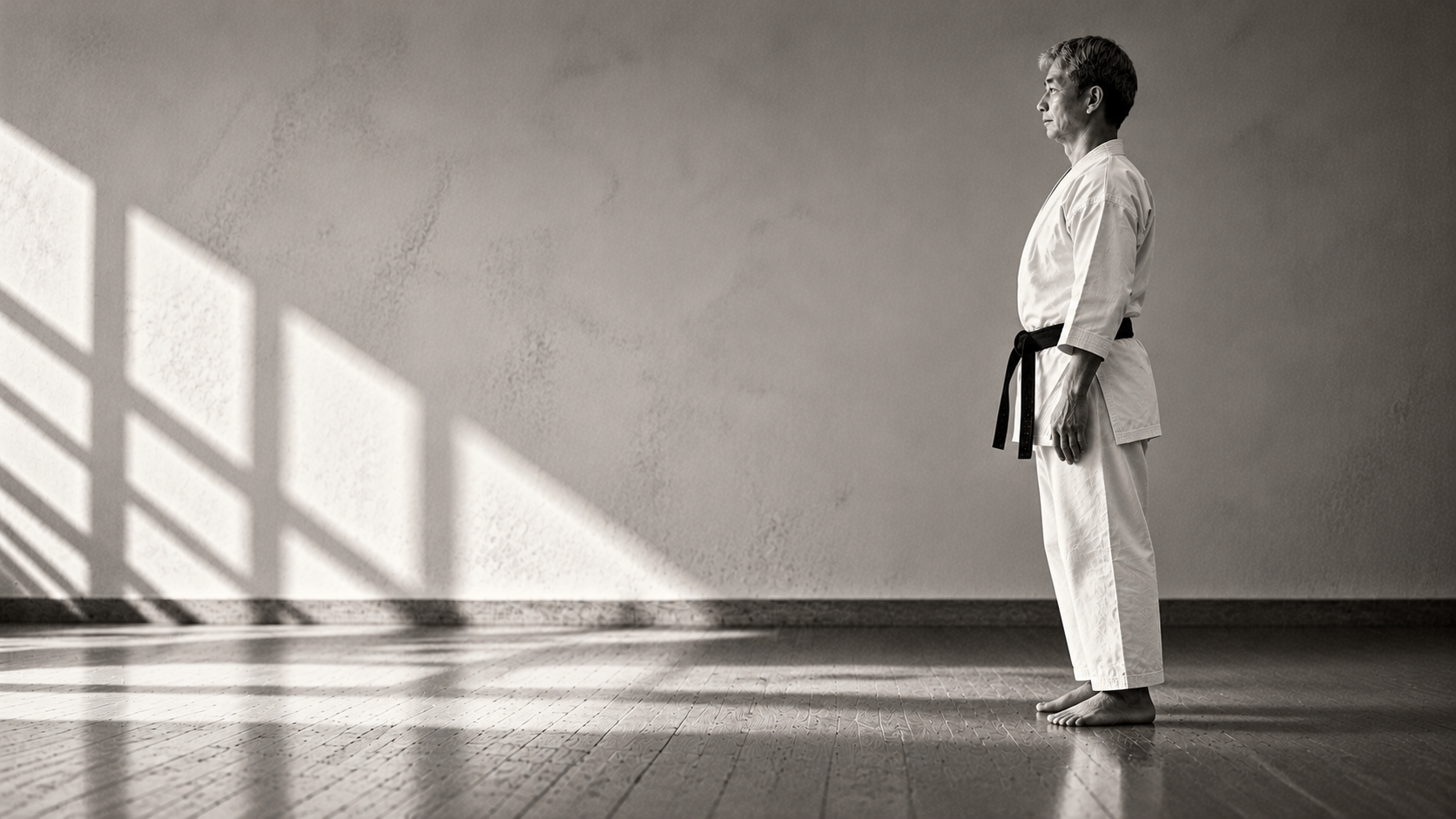
In traditional karate, we place great emphasis on posture. A slight tilt of the head gets corrected, the neck lengthened, the pelvis adjusted, the feet planted carefully into the floor. From the outside, where karate looks like a system for learning to strike, block, and fight, these corrections can seem disproportionate. Yet Nishiyama Sensei could spend years refining what appears to be nothing more than the way a karateka stands. Why?
The answer is not found in karate alone. Every human being must solve the same basic problem: how to organise the body against Earth’s pull. Whether walking, dancing, lifting, or practising karate, the body functions best when its structure is aligned, rather than bent, twisted, or collapsed. Good posture is a human principle. What traditional karate did was subject it to a specific and often ruthless set of demands – the same demands the previous article located in philosophy itself. Karate from Inside: Why Philosophy Matters argued that karate philosophy is not found in aphorisms and slogans but in the mechanism by which fear and ego are managed through physical discipline. Posture is where that mechanism begins – the first place the body encounters the problem, and the first place it learns to hold.
Standing upright while relaxed is easy. Maintaining proper structure while generating force, absorbing impact, controlling fear, and facing someone intent on disrupting that structure is considerably harder. Under that kind of pressure, posture is usually the first thing to disappear – the shoulders rise, the head moves forward, breathing becomes restricted, the spine loses its organisation. The body shifts towards survival, sacrificing efficiency.
What we are doing in karate training, in part, is resisting this collapse – preserving efficient organisation in the moments when the organisation is hardest to hold.
Perceived Danger
The human nervous system has an old, automatic response to perceived danger, and the mechanism is not picky about what triggers it. A fist coming at your face, a near miss in traffic, a difficult conversation, sustained stress at work – the trigger is the perception of threat, not the nature of the threat itself. When it fires, the brain’s survival-oriented circuitry overrides conscious control, and the instructions sent to the body are simple: lower the profile, pull the shoulders up to protect the neck and throat, thrust the head forward towards the danger. This is the startle response, and it does its job well. It protects the throat and the eyes – and it buys the half-second the brain needs to decide what happens next. What it was not built for is what karate demands in that same instant: generating force, holding structure, responding – not once the danger has been absorbed, but while it is still arriving. That mismatch is what pulls the body out of alignment – the raised shoulders, the forward head, the collapsed chest all serve the reflex’s actual purpose, just not karate’s.
In daily life, this reflex fires occasionally and unpredictably, and you are rarely doing anything deliberate about it when it happens. Karate is different in one specific way: it puts you in front of the trigger on purpose, over and over, so that you can practise not falling to pieces when the reflex fires. The processes that follow are not combat-specific. They are what happens to a human body, any human body, the moment it perceives danger. Karate provides a reliable way to make that happen on demand, which is the only way to train against it.
Cascade
Once the head moves forward, even slightly, the (effort and energy) cost increases quickly. The human head weighs 4.5 to 5.5 kg, and when well-balanced atop the spine, this weight is carried almost entirely by the skeleton. At a forward neck bend of just 15 degrees – a common posture when looking down at a phone, or under the startle response – the effective load on the neck rises to around 12 kg; at 30 degrees, around 18 kg; at 45 degrees, around 22 kg. [1] The muscles that should be free to stabilise and move the head now spend their capacity simply holding it up. The upper back rounds to counterbalance the weight, the chest collapses, and the lower back over-arches or flattens to keep you upright.
The consequences of it don’t stay local. The body’s fascia forms a continuous tensional network organised on the principle of biotensegrity, where strength comes from a balance of tension and compression rather than compression alone. [2] A specific pathway, the Deep Front Line, runs unbroken from the arches of the feet, through the pelvic floor, up the front of the spine, to the jaw and base of the skull. [2] Roughly a third of muscle fibres insert directly into fascia rather than tendon, carrying a comparable share of mechanical force along a route most of us assume runs through bone alone. [3]
When the head collapses forward, this entire line (Deep Front Line) shortens, and the tension that should be distributed evenly concentrates instead at the weakest points: the neck, the lower back, the knees. A fault anywhere on the line shows up everywhere else on it – which is also why the cascade does not always begin at the head. Collapsed arches, a chronically tilted pelvis, or fatigue eroding the deep stabilisers are equally valid starting points, producing the same structural failure by different routes. The forces a karateka generates do not disappear when the line is deformed; they convert into twisting and stretching forces on muscle, disc, and ligament instead, paid for slowly, over years. [4]
The collapse also corrupts the signals sent to the brain. A dense cluster of proprioceptors near the base of the skull, together with the vestibular system, normally gives the brain precise information about position and movement – Ruffini corpuscles handling the sustained monitoring a standing structure depends on, Pacinian corpuscles tuned instead to movement and change and prone to going quiet under constant load. [3] The moment the head tilts, or the neck tightens, that information degrades. More critically, research into motor control has identified what this costs in timing: the deep stabilising muscles around the spine and pelvis should activate 30-50 milliseconds before arm movement begins [5], and 110-130 milliseconds before leg movement [6] – the nervous system stabilises the centre before allowing the limbs to move, entirely below conscious awareness. Under poor posture or sustained stress, this timing degrades: the stabilisers fire late or not at all, the spine moves unprotected, and the resulting micro-injury triggers further avoidance, weakening the stabilisers further still. This is why posture erodes quietly, long before strength does.
Lower down is the pelvis, an area where even experienced karateka most commonly leak power. Arch the lower back excessively and force coming up from the legs deflects sideways rather than travelling up the spine. Tuck the tailbone too aggressively and the abdominal muscles lose their ability to pressurise. The pelvis is held level by muscles you can’t see working – the psoas, the pelvic floor, the transverse abdominis – which hold neutral as a baseline, available the instant a technique demands it. [7] When the glutes are chronically underused – what McGill has called gluteal amnesia, the predictable result of sedentary posture – the body compensates by overworking the lower back and quadriceps instead. [8]
The mechanism is simple: the glutes extend the hip and maintain pelvic level. When they stop doing that job, the hip flexors pull the pelvis forward into anterior tilt, and the lumbar spine arches to compensate – the body finds a way to stay upright, but the cost is absorbed by the lower back.
Ground reaction force is then muffled before it ever reaches the trunk. Nishiyama Sensei did not accept this quietly. Sensei Rokah has described returning from his classes with purple buttocks, sleeping on his stomach – Nishiyama Sensei’s corrections were direct, immediate, and left no ambiguity about what needed to engage. [9] [10]
The chain continues below the pelvis. The feet anchor the whole chain, and their failure travels upward. When the feet lack a secure base, the nervous system tightens the shoulders and neck as a defensive reflex – a soft foot produces a hard, slow upper body directly. When the medial arch is active, and the weight is distributed correctly, the ground reaction force travels straight into the bones; when it collapses, the force is absorbed by soft tissues instead. [7]
The body is remarkably good at compensating for all we just explained. A karateka can train for years with a forward head, a tilted pelvis, and underactive glutes, and still function – still develop speed, timing, and reasonable technique. The collapse tends to be gradual and invisible, which is what makes it dangerous. But compensation has a limit, paid in three ways: soft tissue accumulates damage that the structure should have absorbed; workarounds that serve well enough in training disappear under maximum load, when the threat response is firing hardest; and there is a performance ceiling that cannot be bypassed – a karateka can reach a certain level on compensated structure, but cannot go beyond it.
The initiating event is almost always the head – the startle response strikes there first, and everything downstream follows. But the critical failure point, the one that cannot be compensated for, is the feed-forward timing. Deep stabilisers firing before movement begins is the one mechanism no correction can reach after the fact, because the correction would need to happen before the movement was known to be coming. Everything else in the chain can be partially worked around. This one cannot be faked. Everything described in this section – the head, the fascial line, the pelvis, the feet – is the startle response made structural. The question becomes where to interrupt it.
The Eyes and the Structure
Knowing what the trigger does is only useful if there is somewhere to intervene. The clearest point of intervention is the eyes. Nishiyama Sensei identified this as mesen, eye line: maintain direct line connection from face and eyes towards the opponent, the most efficient means of directing body movement. [11] Where your eyes focus determines where your head points, which determines the alignment of the entire vertical axis – so maintaining mesen, simply keeping the eyes directed towards the opponent, helps preserve head position almost automatically, interrupting the startle response’s instruction to thrust the head forward before it can take hold. Part of what the threat response does to the visual system is switch it into rapid, high-alert scanning – the eyes begin jumping between threat points, hands, feet, face. Each jump carries a real cost: the brain briefly shuts down visual processing during the movement itself to prevent a motion-blurred mess, creating a functional blind spot of 30 to 80 milliseconds per jump. [12] In a combat exchange where the available window for response can be under a tenth of a second, those gaps stack into something an experienced opponent can exploit. This is what Sensei Rokah means by “using the eyes makes us late” [13] – a clear description of a physiological delay built into the tracking strategy itself. The soft, broad awareness that mesen describes eliminates those blind spots, which is why beginners track parts while advanced practitioners perceive the whole, and why the eyes are an entry point into the reflex rather than just a consequence of it.
There is a physiological layer underneath this. Research into visually evoked threat responses has found that the mode of visual attention itself shifts the balance between sympathetic and parasympathetic activation – narrow, focused tracking correlates with heightened arousal, while broad, panoramic awareness is associated with calmer autonomic tone. [14] What traditional karate teaches as mesen is not only tactically superior (fewer blind spots) but neurologically calming – the wider gaze settles the system that would otherwise drive the cascade.
Sensei Rokah has connected this directly to emotional regulation: separating strong intention from being overly excited matters because emotional arousal creates tension and contradictory muscle action, which is why students are taught to draw the eyes back, as if looking from further away. [13] This is what Nishiyama Sensei meant by stable emotions. The threat response still fires; the danger is still registered. What changes is that the cascade described in the previous section – head forward, structure collapsed, signal degraded, timing disrupted – does not follow automatically. The reflex is separated from its structural consequences. That separation is what stable emotions describes, and it is the outcome of the training – the outcome this article has been outlining. [11] Posture and emotional state regulate each other in both directions, as part of the same system, which is why the lever works from either side: settle the eyes and the structure follows, or settle the structure and the eyes follow.
Aiko San, formally Nishiyama Sensei’s secretary, understood this lever better than almost anyone in Traditional Karate circles, despite having no formal karate training of her own. She had a dance background from UCLA, and she could correct Sensei Rokah’s technique without even looking at him, just by listening to the sound of his breath – telling whether energy went through or stopped at kime, whether the technique came from the lower abdomen or engaged the upper body unnecessarily. [10] What she heard in the breath, she could read in the head. At one of the national championships, she gave Sensei Rokah advice that has stayed with him ever since: “imagine your head as a ball resting delicately on your shoulders; if it is going to fall, it should fall between your legs, not to either side”. Sensei Rokah later said that this single piece of advice was worth more than winning five national championships – that power is a by-product of alignment, and the head is the clearest indicator of whether the structure is functioning. [10]
The discipline of catching the body structure’s collapse does not end when training ends, which is the entire point. Sometimes, after hours of training, Sensei Rokah would be exhausted and slouch, and Nishiyama Sensei would sneak up behind him in the hallway and hit his back hard, with the same instruction every time: “training is only a few hours a day, but the rest of life is much longer”. [10] If posture only holds while you are being watched, or while you feel strong, it has not actually been trained – it is a performance for the dojo, not a structural fact about you. The trigger that collapses posture in kumite is the same trigger that fires in an argument, a deadline, or a moment of fear that has nothing to do with karate. What gets trained against a fist extends to other domains because the reflex being separated from collapse is the same reflex either way.
In traditional karate, this continuous maintenance of your focus has a name: zanshin. Usually translated as “remaining mind” – the alertness maintained after a technique rather than released with it – zanshin is often understood as a combat concept, something belonging to the space between attacks. Sensei Rokah’s hallway story points at something more fundamental. Zanshin is not what you maintain after a technique. It is what you maintain always, because the reflex that collapses structure does not ask whether you are between attacks or between training sessions – and either the nervous system carries the baseline, or it does not. Nishiyama Sensei was not correcting Sensei Rokah’s posture. He was insisting on zanshin.
None of this is only about avoiding collapse, either. A structure that holds under the trigger is also the structure that transmits force without loss – the same discipline that prevents injury is what makes technique heavy rather than just fast. Keeping structure and using it efficiently are one achievement seen from two directions.
From Posture to Stance
Everything described so far – the collapse, the recovery, the discipline of holding structure under pressure – happens within specific shapes. Those shapes are the stances, and the distinction between posture and stance is important to understanding how the system works. Posture is a set of mechanical conditions the body must satisfy to function efficiently, especially under load. The conditions don’t change whether you’re in zenkutsu-dachi or neko-ashi-dachi, whether you’re attacking or defending, whether you’re fresh or exhausted. They apply equally whether you are standing still, walking, running, blocking, or striking.
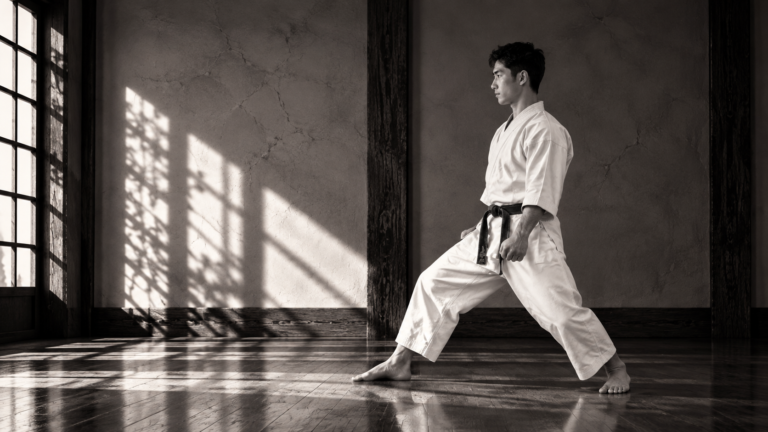
A stance is a posture made specific: a particular configuration of the feet and legs adopted to solve a specific mechanical problem. Why zenkutsu-dachi? To direct force efficiently forward and backwards. Why kokutsu-dachi? To keep the weight uncommitted, ready to block or retreat while adjusting distance. [15] Why kiba-dachi? To withstand force coming from the side. Each stance is a different geometric solution to a different problem of movement or impact, changing shape to optimise leverage, stability, or range of motion for the task at hand. But none of these stances works unless the underlying posture is correct. You can have the perfect foot position, exactly the right knee angle, and ideal weight distribution, but if your spine is twisted, your pelvis tilted, or your head forward, the stance is just a shape. It looks like karate, but mechanically, it does not work. It leaks power and fails under pressure. The stances are the visible vocabulary of karate, but posture is the grammar that gives them meaning.
Keep Trying
When we asked Nishiyama Sensei about a technique or expressed difficulty getting something to work, the answer was the same: keep trying. This sounds like an instruction to persist, but it was not. He said just enough to give direction, then wanted you to find the answer through training. Train, then contemplate. Repeat, but not mechanically – reflect on what you do, stay open to the subtle difference, because the understanding can only come through the doing. That is what keep trying means. [10]
Everything described in this article is subject to the same instruction. The reflex does not stop firing. The cascade does not become easier to interrupt. The work of separating structure from threat is never finished – it only becomes more precise. The body follows the mind, and the mind learns through the body. Neither leads, except by turns.
References
[1] Hansraj, K., “Assessment of Stresses in the Cervical Spine Caused by Posture and Position of the Head,” Surgical Technology International, 25, 2014
[2] Myers, T., Anatomy Trains: Myofascial Meridians for Manual and Movement Therapists, Churchill Livingstone, 2001
[3] Slater, H., Barclay, S., Granfar, R., and Pratt, R., “Fascia as a Regulatory System in Health and Disease,” Frontiers in Neurology, 15, 2024
[4] Rokah, A., “Posture and Performance,” avirokahkarate.blogspot.com, 2009
[5] Hodges, P.W. and Richardson, C.A., “Feedforward Contraction of Transversus Abdominis Is Not Influenced by the Direction of Arm Movement,” Experimental Brain Research, 114(2), 1997
[6] Hodges, P.W. and Richardson, C.A., “Contraction of the Abdominal Muscles Associated with Movement of the Lower Limb,” Physical Therapy, 77(2), 1997
[7] Rokah, A., “More Stance: How Deep and Wide and Why?” avirokahkarate.blogspot.com, 2012
[8] McGill, S., Ultimate Back Fitness and Performance, Backfitpro, 2004
[9] Rokah, A., “Efficient Technique is for Fighting and Injury Prevention,” avirokahkarate.blogspot.com, 2015
[10] Rokah, A., “Sensei Nishiyama the Practical and the Philosopher,” avirokahkarate.blogspot.com, 2013
[11] Nishiyama, H., Traditional Karate Coach’s Manual, International Traditional Karate Federation, 1989
[12] Vater, C., Kredel, R., and Hossner, E-J., “Examining the Functionality of Peripheral Vision: From Fundamental Understandings to Applied Sport Science,” Current Issues in Sport Science, 2, 2017
[13] Rokah, A., “Less Is More, Soft Is Strong (Part Two),” Shotokan Karate Magazine, Issue 97, October 2008
[14] Balban, M.Y. et al., “Human Responses to Visually Evoked Threat,” Current Biology, 31(3), 2021
[15] Rokah, A., “UKE Waza (Blocking Techniques), Part 2: Principles of Applications,” avirokahkarate.blogspot.com, 2010
Leave a Reply