Author's Note:
This article is the third in a series exploring the science behind Traditional Karate as taught by Sensei Hidetaka Nishiyama and transmitted by Sensei Avi Rokah. It builds on the mechanical perspective of "The Continuous Web" and the regulatory perspective of "The Inner Web," offering a framework for how these layers integrate in practice. Any errors of interpretation are entirely my own.
Andrzej
One Body
Science studies the human body by dividing it into systems — muscles, connective tissue, nerves, perception. Each can be examined separately, and there is value in doing so. In practice, however, there are no divisions. There is only the body acting as a whole.
Anyone who has spent time in a dojo has seen this directly. In a line of karateka doing basic kihon, the quality varies. Some move tense and mechanical; others relaxed and decisive. The external form looks almost identical. The internal coordination does not. Which raises a simple question:
What actually produces an effective technique?
The answer does not lie in any single quality — strength, flexibility, or reaction speed alone. It lies in how well the body’s systems work together. Traditional karate developed training methods that gradually integrate these systems into a connected unit, though without using modern scientific vocabulary. What it discovered through observation, modern science is now confirming. This article explores the layers of human functioning that traditional karate trains and how they work together.
Structure
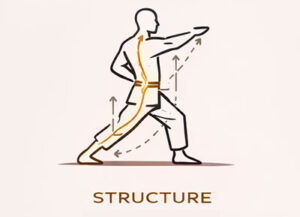 The first layer is mechanical organisation.
Karate instructors insist on starting the technique by pushing the floor. Force originates from interaction with the ground and travels through the body’s structure. When this connection is missing, the technique becomes shallow – generated only from the arms and shoulders (“top power”). Sensei Rokah recalls: Our purpose in karate is to make most efficient use of the human body and mind – the whole body should cooperate in each technique. As Nishiyama Sensei used to say: ‘What is the point of having an eight cylinder car if you can use only two cylinders? Must use all eight. [1]
The connective tissue network known as fascia links the feet, legs, torso, and arms into a continuous mechanical system [2]. When the body is organised correctly, force travels through this structure smoothly; excessive muscular tension interrupts the chain, making movement segmented and inefficient. Sensei Rokah emphasises the chain reaction: Technique is chain reaction from the ground up – if our technique is initiated from the feet, we will not move the extremities in isolation, the whole body will cooperate.[3]
Traditional instruction emphasises whole-body movement, grounded posture, and relaxed shoulders. These corrections preserve the chain: Optimal posture allows for effortless control of body dynamics, and the full range of muscles contraction/relaxation, and for smooth transmission of forces through joints. [3]
(For a detailed exploration of how fascial integration develops through training, see The Continuous Web: Understanding Fascial Training in Traditional Karate on this blog.)
Regulation
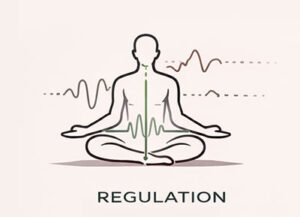 The second layer is nervous system regulation.
Experienced practitioners often speak about zanshin – the remaining mind – a state of relaxed alertness that extends beyond the dojo. Its complement is fudōshin — the immovable mind — the state where neither fear nor doubt can destabilise the practitioner’s structure or perception. Together, they describe what good regulation actually feels like from the inside. This quality reflects the state of the autonomic nervous system. Breathing patterns, posture, and attention influence how the body balances activation and recovery. When regulation is stable, perception remains clear and muscular tension does not overwhelm the body’s structure [4,5]. Sensei Rokah captures this balance: Mind like ice, spirit like fire. One must keep the mind calm and the spirit strong, however the mind must not be carried away by the spirit and vice versa.[6] He connects this to breath: If the breath rises to the chest, we cannot control our body center or feet. This happens when we are over excited and lose stable emotions, but if we can keep the breath in the center it allows us to keep stable emotions and remain mentally as well as physically centered.[6]
The capacity to remain alert without being overwhelmed is not a martial arts secret – it is a universal human skill, trainable through consistent practice. Sensei Rokah captures the outcome:
Hard training makes confidence; confidence allows for stable emotions. [6]
(For an exploration of how nervous system regulation develops through training, see The Inner Web: Nervous System Regulation in Traditional Karate on this blog.)
Perception
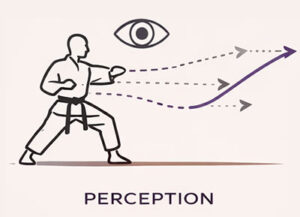 The third layer is perception and anticipation.
Human perception is not purely reactive. The brain constantly predicts what comes next, then adjusts when reality differs [7]. Through training, practitioners become sensitive to subtle signals: shifts of weight, small changes in rhythm, variations in muscular tension, or slight changes in distance. These cues often appear before any visible technique begins. Experienced practitioners respond not to the attack itself, but to what announces it. Traditional martial arts developed a rich vocabulary for the mental dimensions of perception. The foundation is shoshin – beginner’s mind – not the absence of knowledge, but the presence of openness. The willingness to see what is actually there, without the interference of assumption. From this openness arises mushin – no mind – a state of awareness free from interfering thoughts, analysis, or fear. The traditional vocabulary for how this awareness operates is precise: Enzan no Metsuke – looking at the far mountain – where the eyes do not fix on a single point but take in the whole scene; and Kan-Ken no Metsuke, the distinction between Ken, seeing with the physical eyes, and Kan, seeing with the mind’s intuition. Together they describe a quality of attention that is simultaneously broad and deep – not looking at the fist, but reading the whole opponent. The outcome is yomi – reading – the active perception of the opponent’s intention before it becomes action. This is the gan in Ichi-gan. Sensei Rokah describes this as a trained skill: The brain monitors, is aware of all the actions and the information, but once strategy is decided and interaction starts, the choices of action are subconscious, which is the only way to flow and be ahead of the opponent.[8]
He points to a striking example from outside karate. Japanese neurologists studied soccer star Neymar and found that his brain activity during complex foot movements was less than 10 percent of amateur players. Sensei Rokah comments: This low activity of the brain is beneficial to any sport when many decisions have to be made in a short time. … in karate the method is passed from generation to generation, we have a system by which anyone can attain this state of mind. [8] Sensei Rokah connects this directly to the feet: Feet make top technique, action from feet, feet are the ‘boss.’ … Rather than our brain making decisions, the feet do, preventing over-information, hesitation and doubt, which in turn allows for stable emotions.[6]
(For a comprehensive exploration of ma-ai as the space between opponents, see Ma-ai: The Space Between on this blog.)
Interaction
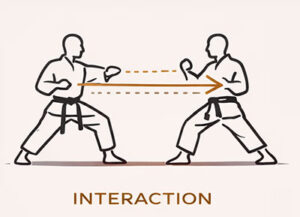 The fourth layer is interaction.
When two practitioners face each other, distance, timing, rhythm, and intention constantly change. Each participant is predicting and adjusting to the other – and this is the essence of ma-ai. Within this space, small instabilities occasionally appear: a shift in balance, a hesitation in rhythm, a momentary lapse of attention. These are the moments traditional karate calls kyo – openings that are brief, but decisive. Sensei Rokah warns: This is dangerous because if we miss or not finish the fight with one technique, then there will be a kyo, space for the opponent to catch us.[9]
Technique becomes effective not through force alone but through acting precisely when the opponent’s system becomes unstable. Japanese swordsmen understood that controlling ma-ai means controlling timing. They developed the concept of muhyōshi – no-beat – moving without a discernible rhythm that the opponent can anticipate. When you move in your opponent’s rhythm, you become predictable. When you move without rhythm, you create the opening you need. Sensei Rokah describes the breath as the key to fluidity in this interaction: The breath is the trigger; the muscles follow the breath. [9]
And he notes that an effective technique does not create a pause: When we make kime and deliver energy, we are recharging at the same time. The more complete the kime the better the preparation.[10] The ability to act without creating an opening is the hallmark of skilled interaction.
(For a comprehensive exploration of ma-ai as the space between opponents, see “Ma-ai: The Space Between” on this blog.)
From Perception to Technique
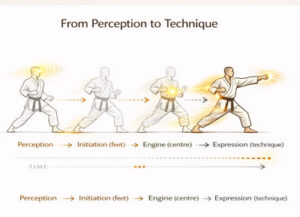
Many martial arts traditions share a common principle: Ichi-gan, Ni-soku, San-tan, Shi-riki, which in modern language translates as perception → feet → centre → technique.
Nishiyama Sensei placed this principle at the heart of his teaching, applying it to every technique in his seminars without exception. Sensei Rokah describes the practical application:
Making action from the feet is a very physical skill that sets the optimal mental mode.” [6]
The first element, gan (the eyes), refers not simply to looking but to perceiving the opponent’s intention. Perception triggers everything that follows.
The second element, soku (the feet), initiates the action. Rather than moving the hands or body centre first, the feet initiate.
The third element, tan – the centre, or tanden – follows the initiating step, adding the body’s mass and power to the movement. Sensei Rokah describes the centre as the engine:
The body center is the engine. Technique is initiated from a firm center using ground reaction.[3]
Only at the final moment does riki – the technique itself – appear. The fist moves last, receiving power transferred through the body.
Practitioners often struggle with this ordering because the natural human tendency is the opposite. Most people’s instinct is to react with their arms/fists first – they are closest to the target. Or the body centre and arms move together. When this happens, the movement becomes inefficient and telegraphs the intention.
When the sequence is correct, the motion becomes much harder to detect. The feet initiate, the centre follows, and the technique appears only at the final moment. Technique is not the starting point; it is the final expression of an integrated system. As Sensei Rokah describes the endpoint of this process: At an advanced level, there is only breath and intention. All the details will happen by themselves.[6]
The Layers of the System
Traditional karate training develops several interconnected layers of human functioning – each with its own traditional vocabulary and modern correlate:
INTERACTION
(ma-ai — dynamic timing)
▲
PERCEPTION
(yomi — predictive perception)
▲
REGULATION
(fudōshin — autonomic balance)
▲
STRUCTURE
(kamae — kinetic chain)
The sequence: perception → feet → centre → technique is the practical expression of these layers in movement. Each layer depends on the one below it.
A Modern Parallel
This layered organisation is not arbitrary; it reflects the underlying architecture of the human nervous system itself. Lower brain regions – the brainstem and cerebellum – automatically regulate posture, balance, breathing, and basic bodily functions. Above these, the basal ganglia and motor cortex coordinate movement patterns and learned habits. At the highest level, cortical networks handle perception, prediction, and the construction of goals. Finally, specialised systems – sometimes called the social brain – allow us to interpret the actions and intentions of another person standing across from us. This biological hierarchy maps directly onto the four layers of training: structure, regulation, perception, and interaction – bottom to top, in the same order.
A related logic appears in modern research on motor control and robotics. Engineers designing complex machines rarely control movement at the level of individual joints. Instead, they organise behaviour hierarchically – goal first, then structure, then coordination, then execution. This maps onto how the layers express themselves in movement: perception → feet → centre → technique. Two different parallels, the same underlying insight: effective action emerges from the whole, not the parts.
The Cascade: When Layers Uncouple
These layers are not just stacked – they are coupled. A shift in one instantly perturbs the others. Any practitioner who has trained under pressure knows what happens when one layer fails. When structure breaks – posture collapses, ground connection is lost, and shoulders rise – the nervous system immediately responds. Breathing shifts to the chest, tension floods the body, and the calm regulation that allows clear perception disappears. Sensei Rokah notes the mechanism: When the lumbar spine is flexed it is 40% weaker in producing force, and more susceptible to injury.[3]
The practitioner stops reading the opponent and starts reacting to whatever arrives. Interaction becomes survival rather than strategy. Technique, if it appears at all, comes from the arms alone. Every karateka has experienced this cascade. A moment of doubt, a loss of footing, an unexpected attack – and suddenly the whole system degrades. Not one layer at a time, but all at once, because they were never truly separate.
The coupling also runs upward. The mental state reaches the body before any physical contact occurs. Anxiety raises the shoulders; fear changes the breath; disrupted breath destabilises the centre. A mental state can dismantle a well-trained body in an instant – which is why traditional karate training addresses posture, breath, and awareness together rather than treating them as separate skills. Sensei Rokah describes how breath connects the layers in both directions: The breath from the body center interacts with the feet to maximize use of ground reaction. It is really the breath that initiates the feet and allows the feet to be the ‘boss.’ [6]
When the layers are working together – when the coupling is stable – the experience is unmistakable. The body feels connected and quiet, breathing is low and steady, and perception is broad without effort. The opponent’s intentions seem to arrive early, and technique emerges without deliberation. This is not a peak state reserved for masters. It is what good training produces on an ordinary Tuesday evening – briefly, imperfectly, but recognisably.
Beyond the Dojo
These layers are not unique to the dojo. Consider something most people have experienced but rarely examined: when bad news arrives, the shoulders rise before the mind has fully processed what it heard. The body responds to psychological threat with the same structural collapse as physical threat. Posture changes, breathing shifts to the chest, perception narrows. The cascade runs – in a meeting room, in a hospital corridor, in a difficult conversation – exactly as it does when structure breaks under pressure in training.
Most people know they carry tension in their shoulders. Few realise that the shoulders rising is the first link in a chain that ends with impaired perception and poor decisions. Traditional karate training addresses this chain directly – not because it was designed for meeting rooms, but because the body is the same everywhere. Physical therapists understand this intuitively. They do not treat an injured shoulder in isolation – they examine posture, breathing, and movement patterns throughout the body. A shoulder problem often originates in the thoracic spine or the pelvis. You cannot fix one layer while ignoring the others.
The Real Subject of Karate?
Traditional karate is not (and never was) just the study of techniques. Techniques are the visible expressions of deeper processes. The real subject is how the human body behaves under pressure – physical or mental. Generations of practitioners explored this through careful observation and repeated practice. Today, biomechanics, neuroscience, and systems theory offer additional ways to describe the same phenomena. Traditional texts spoke of ki – a term that resists direct translation. The science does not use that vocabulary, but it offers a framework for describing the integrated physiological reality that traditional practitioners observed: the coordination of breath, structure, and intention acting as a unified whole. I have spent more than four decades exploring this subject – through training, through the teachings of Nishiyama Sensei and Sensei Rokah, and more recently through modern science. And the conclusion?
Stand in the dojo after a good training session – one where the breath was settled, the connection through your body held, and the awareness kept. Notice how your body feels. A collection of parts – or simply your body? That feeling is not imagination. It is the layers coupled and operating together, rare at first, and with practice, reliable. The insight behind the training is simple: we have only one body. Traditional karate, at its best, is learning how to use it fully.
References
- Rokah, A. (2014). Does Repetition Make Perfect? Avi Rokah’s Karate Blog.
- Myers, T. W. (2014). Anatomy Trains: Myofascial Meridians for Manual and Movement Therapists (3rd ed.). Churchill Livingstone.
- Rokah, A. (2015). Efficient technique and injury prevention go hand in hand. Avi Rokah’s Karate Blog.
- Porges, S. W. (2011). The Polyvagal Theory: Neurophysiological Foundations of Emotions, Attachment, Communication, and Self-regulation. W. W. Norton & Company.
- Thayer, J. F., Yamamoto, S. S., & Brosschot, J. F. (2010). The relationship of autonomic imbalance, heart rate variability and cardiovascular disease risk factors. International Journal of Cardiology, 141(2), 122-131.
- Rokah, A. (2015). Mind like Ice, Spirit like Fire. Avi Rokah’s Karate Blog.
- Clark, A. (2013). Whatever next? Predictive brains, situated agents, and the future of cognitive science. Behavioral and Brain Sciences, 36(3), 181-204.
- Rokah, A. (2014). Bypass the brain in karate and in soccer… Avi Rokah’s Karate Blog.
- Rokah, A. (2015). Strong technique – fluid transitions. Avi Rokah’s Karate Blog.
- Rokah, A. (2019). Developing Kime (shocking power). Avi Rokah’s Karate Blog.
© Andrzej Czyrka / nyuanshin.com
This article may be shared, reprinted, or quoted for non-commercial purposes provided the author is credited and a link to the original article at nyuanshin.com is included. Commercial use requires prior written permission.
Leave a Reply