The beginning
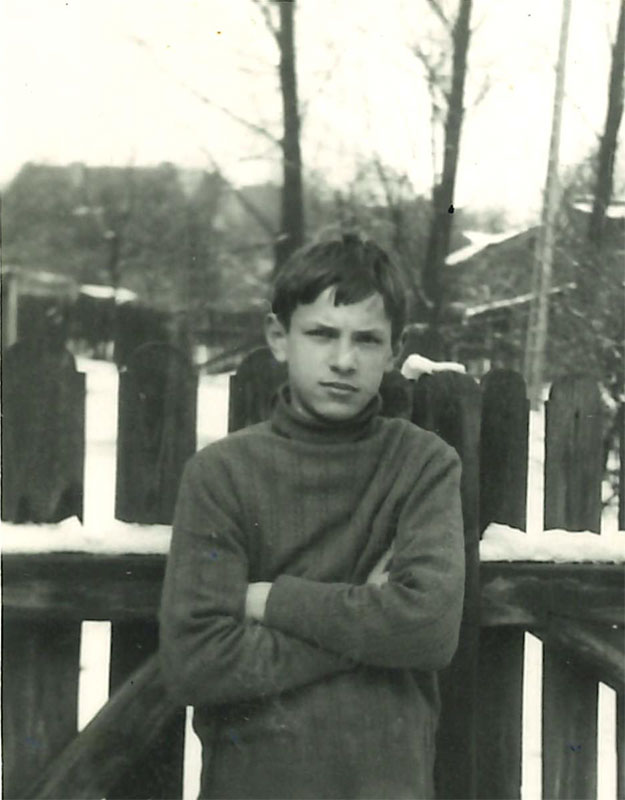
I first stepped into a dojo at fifteen — a skinny child in a crowded school hall in Lubaczów, where more than 40 teenagers were breathing in the mysticism of Japanese commands and trying to imitate the unfamiliar movements of hands and legs. I wanted to prove that I wasn’t as weak as I looked (and had been told my whole childhood).
Soon after, diagnosed heart murmurs stopped me for 3 years. The medical authorities said “no” to karate training (and to any strenuous physical activities in general). But somewhere in that pause, something shifted — I realised I couldn’t simply hand over decisions about my own body to others. When I came back to training (first year of my physics study), it was with a different understanding: that whatever happens, the training itself is the point. I’m sixty-two now. The murmurs are still there. So am I. Forty-seven years older and still in the dojo, on the tatami, still in a gym.
My background is in physics — I studied at university with a teaching specialisation and spent several years in the Theoretical Physics department, researching Szekeres solutions of the Einstein field equations. The analytical approach I developed and used shaped the way I think about movement, karate and “things” in general. When I write about body dynamics, ground reaction forces, or fascial integration, I’m not borrowing metaphors — I’m applying the same analytical framework to a different domain.
Where this comes from
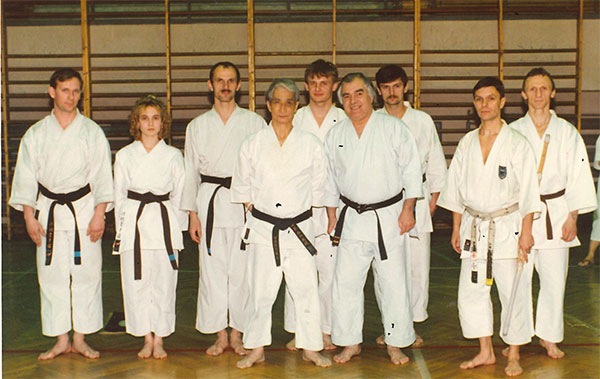
In 1990, I attended a seminar with Hidetaka Nishiyama Sensei in Kraków. I had trained under other Japanese karate masters before. This one was different. The depth of his understanding — the precision, the insistence that every detail served a purpose, and the explanation which followed – was unlike anything I had encountered. I was hooked immediately. (But it meant to start my whole karate training…again :-)) Two years later, I trained with Sensei Avi Rokah for the first time. Where Nishiyama Sensei had articulated principles that felt deep (and difficult to apply), Sensei Rokah embodied them in a way that made the path visible. He didn’t simplify — he clarified. He showed that Nishiyama’s teaching wasn’t abstract philosophy: it was a method, and it could be transmitted. Since then, I have trained with Sensei Avi at every opportunity — attending his seminars whenever he is in Europe, testing my understanding against his corrections. He awarded both my 4th and 5th Dan grades. The clarity (if any at all) in my teaching and writing comes from this tradition: Funakoshi to Nishiyama to Rokah. The transmission isn’t complete – it never is – but the direction is clear.
What this site is
Nyuanshin – 初心 – means beginner’s mind. It’s the idea that true learning requires you to stay open and be ready to challenge what you think you already know. Nishiyama Sensei put it simply: Once you think you know, you are finished, you don’t learn anymore.
The articles on this site explore the biomechanics, training principles, and philosophy of traditional karate as transmitted through the Nishiyama–Rokah methodology. Some draw on movement science and motor learning research. Some are more personal. All reflect my current understanding — which means some will need revising as that understanding deepens. That’s the point. I write because writing forces precision. In the dojo, you can get away with a feeling; on the page, you have to explain it. The process of explaining is how I test whether I actually understand something or just think I do.
The path
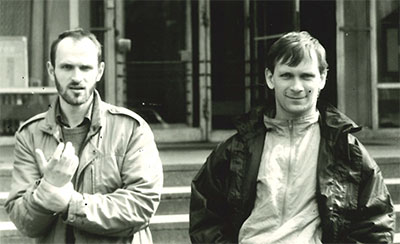
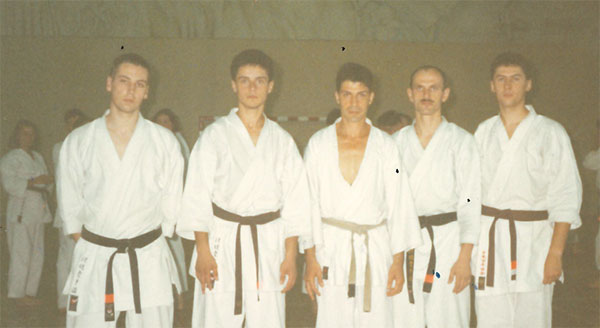
I trained for nearly two decades in Rzeszów, Poland – at a club led by Sensei Ryszard Kolano (5th Dan) and Sensei Mariusz Kazanowski (3rd Dan). I competed for over ten years as a kumite team member and won many competitions along the way. Mariusz became a close friend and training partner; we still train together every time I’m back in Poland. Those years built the foundation.
In 2002, I moved to the UK. I visited several clubs in London and found the same pattern everywhere: the old Japanese model of “copy me, keep your spirit, don’t ask questions.” For someone trained to ask why — both in physics and in the dojo — that wasn’t enough. In 2005, I established Traditional Karate Club Nyuanshin. The aim was simple: train in the Nishiyama–Rokah methodology with the depth and rigour it demands, in an environment where questions aren’t just tolerated but expected. Over the past couple of years, I’ve stepped back from regular classes and now work only with individuals — one-on-one sessions focused on depth rather than breadth.
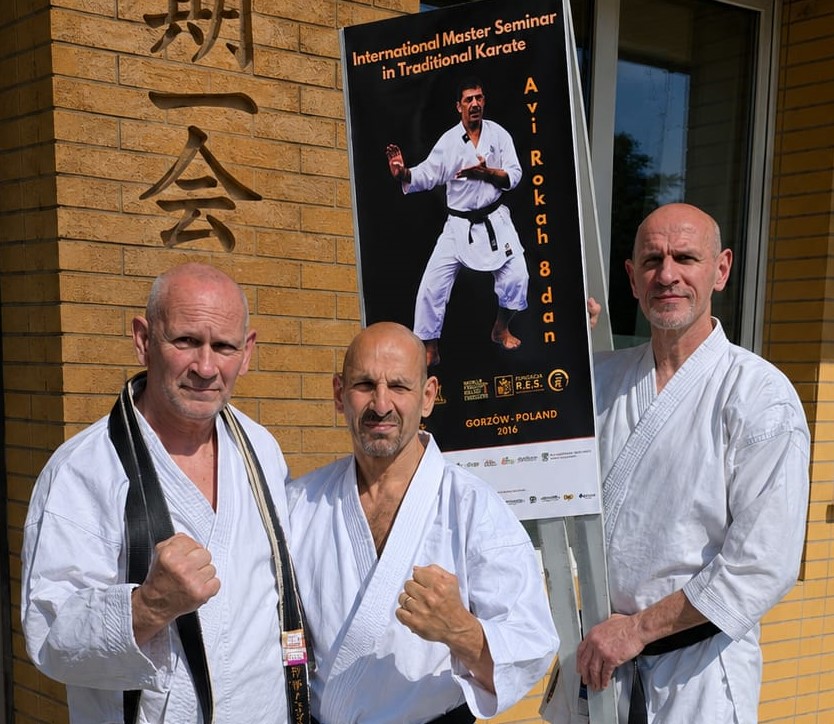
My long-standing training partner here in the UK is Mario Kalli (5th Dan) — a friend and fellow student who shares a similar approach and training philosophy. His article on power generation in karate is in the blog archive if you want a second voice on similar themes.
Contact
If you want to get in touch — about training, about the articles, or to disagree with something I’ve written — you can reach me at info@nyuanshin.com.