Part 3 – The Philosophy and Integration
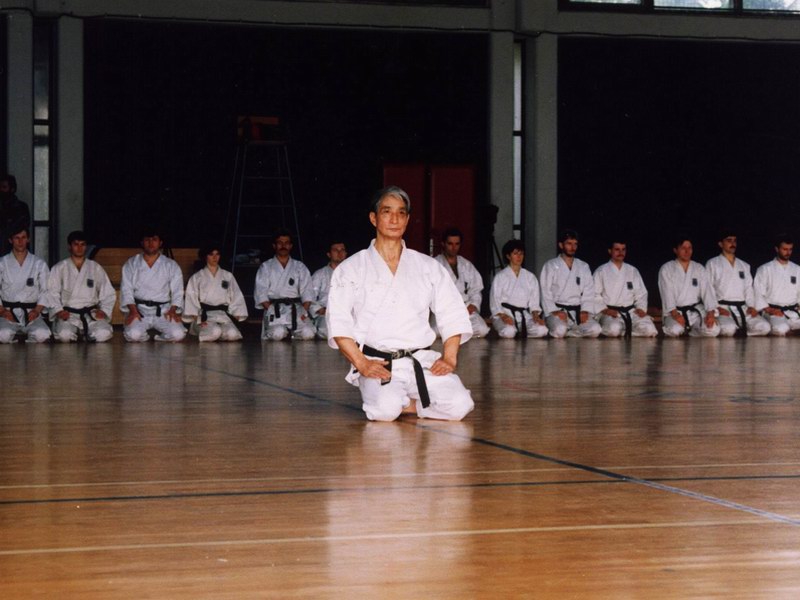
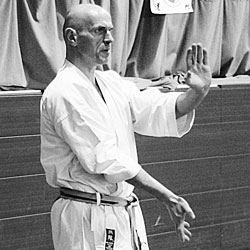
Sensei Nishiyama often reminded us, “Once you think you know, you are finished — you don’t learn anymore.” For him, philosophy was not an idea but an action. Sensei Avi Rokah, who studied under him for many years, recalls: “The philosophy that Sensei taught was in the doing, not in words.” [7]
That insight reveals the heart of traditional karate. The deeper lesson isn’t hidden in lectures or quotations; it’s expressed through how we move, repeat, and refine. Technique is the medium through which understanding develops and matures.
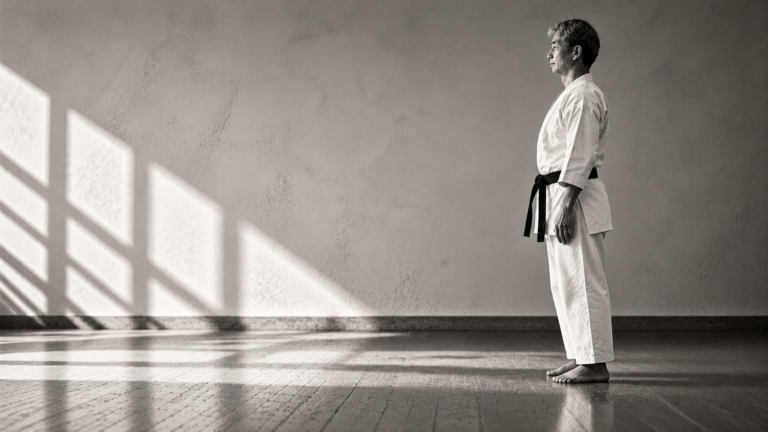
Sensei Avi once wrote, “Form is limitation — a necessary limitation. Therefore, ultimately we should be free of form.” [10] At first, form is everything. It’s the structure that teaches us alignment, power, and control. But as we internalise those principles, the form becomes transparent. The goal is not to reject it, but to transcend it — to reach a place where the body applies the principles freely without conscious thought.
He continues: “Optimal form is not an end; it is a means — a vehicle through which we discover, understand, and internalise the underlying mental and physical principles.” [8] In that sense, slow practice gives us the vehicle; fast practice lets us drive it through unpredictable terrain. The more deeply we grasp the principles, the less the form confines us.
Sensei Nishiyama compared the beginner to “a figure of clay,” shaped but rigid. With time, the clay becomes flexible — “a lively, adaptable doll whose shape can change freely.” What begins as constraint becomes possibility.
Sensei Nishiyama’s emphasis was never on collecting more techniques but on exploring one until it revealed its inner logic. When a movement starts to feel dull, it isn’t that the technique has lost life — it’s that we’ve stopped investigating. As he taught, there is “the beauty of one finishing-blow technique.” The more we look into it, the more layers appear: biomechanics, rhythm, timing, intent, and spirit.
The slow–fast divide shows why mastery is endless. Each speed exposes different aspects of truth: slow reveals structure; fast reveals adaptability; experience fuses the two into instinct. Beneath them both lies the same principle — efficiency born of understanding.
At some point, logic reaches its limit. You can study, analyse, and reason, but the body itself must complete the lesson. True understanding grows out of repetition and reflection — the mind observing the body’s discoveries.
Slow training teaches form; fast training teaches formlessness. Together, they complete the circle of practice. The beginner builds structure through attention; the advanced practitioner moves freely through awareness. Science took decades to confirm what good teachers already knew: the nervous system changes differently when we train slowly and when we train fast. Tradition had the wisdom; modern research simply gave it language.
Traditional karate, passed through the Funakoshi–Nishiyama–Rokah line, has always recognised this unity. The strict form of kihon and kata builds the foundation; the freedom of kumite reveals its living nature. One without the other is incomplete.
And as Sensei Nishiyama used to conclude after a seminar, the message is simple: “Now you know. Go and train.” 👊
References and Sources
[1] Blischke, K., & Malangré, A. (2017). ‘Task Complexity Modulates Sleep-Related Offline Learning in Sequential Motor Skills.’ Frontiers in Human Neuroscience.
[2] Karni, A., et al. (1998). ‘The acquisition of skilled motor performance: Fast and slow experience-driven changes in primary motor cortex.’ Proceedings of the National Academy of Sciences.
[3] Diedrichsen, J., & Kornysheva, K. (2015). ‘Motor skill learning between selection and execution.’ Trends in Cognitive Sciences.
[4] Fitts, P.M., & Posner, M.I. (1967). Human Performance. Brooks/Cole.
[5] Swinnen, S.P., & Wenderoth, N. (2004). ‘Two hands, one brain: cognitive neuroscience of bimanual skill.’ Trends in Cognitive Sciences.
[6] Blischke, K., & Malangré, A. (2017). ‘Task Complexity Modulates Sleep-Related Offline Learning in Sequential Motor Skills.’ Frontiers in Human Neuroscience.
[7] Rokah, A. ‘Sensei Nishiyama, The Practical and The Philosopher.’ rokahkarate.com.
[8] Rokah, A. ‘Form and Principles.’ rokahkarate.com.
[9] Yadav, G., & Mutha, P.K. (2023). ‘Reflecting on what is skill in human motor skill learning.’ Frontiers in Psychology.
[10] Rokah, A. ‘Form and Formless.’ World Budo Karate Association Archive.
Leave a Reply