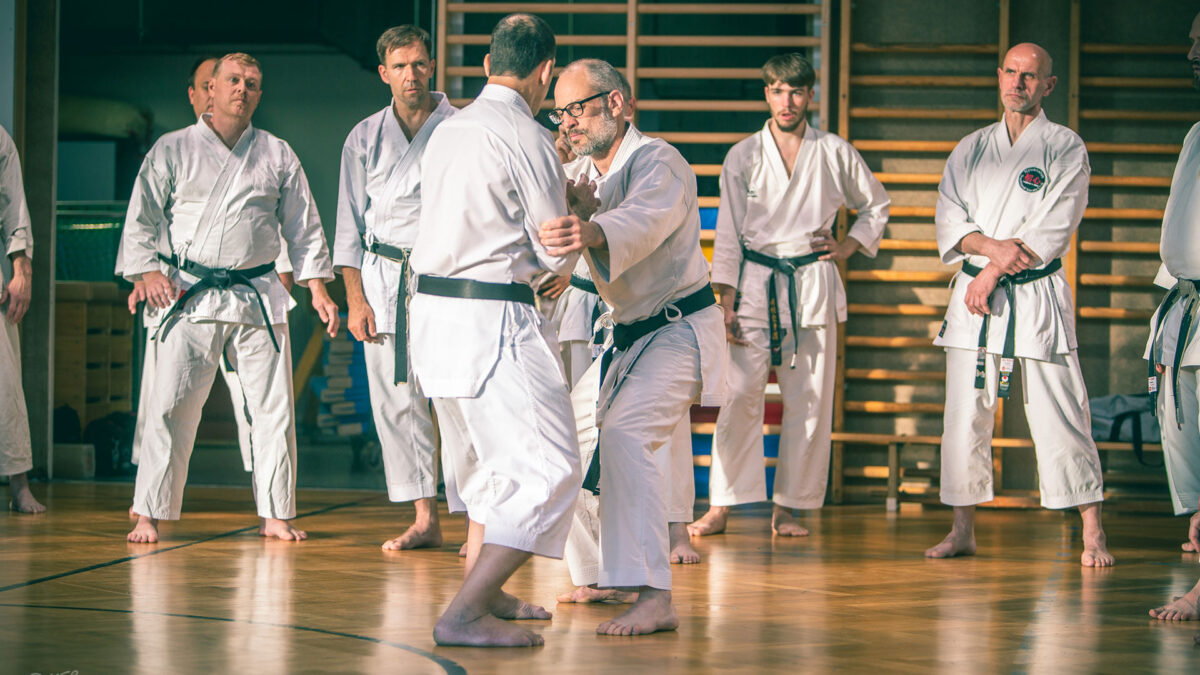
This three-part series explores a simple but often misunderstood truth: techniques performed slowly and techniques performed at speed are not the same.
Drawing on motor learning research, traditional methodology, and the teachings of Sensei Hidetaka Nishiyama and Sensei Avi Rokah, it examines how slow and fast practice build different forms of understanding.
Part 1 uncovers the problem through science and observation.
Part 2 explores practical solutions and training applications.
Part 3 connects technique with philosophy — tracing the journey from form to formlessness.
Part 1 – The Problem (and the Science)
We all have felt it – that strange collapse when a technique that feels good at half speed suddenly falls apart at full speed. The timing shifts, balance slips, and the calm awareness (zanshin) disappears. After years of training, we reassure ourselves: “Fast is just slow, but faster.” But it isn’t.
A stroll and a car chase both move you through space, but the skills, sensations, and demands are entirely different. Slow and fast training feel different because they are different — physically, neurologically, and conceptually. Once that’s clear, everything about how we should train begins to change.
When we move slowly, a combination flows with control and precision. But as soon as we add speed, it shatters. The usual advice — “just go faster” or “do more repetitions” — rarely fixes the issue. If we can perform it well at half tempo, why can’t we sustain it when it counts? Because the two versions aren’t the same technique.
This becomes obvious in complex sequences — a kizami zuki–block–gyaku zuki might hold together, but add a sweep and/or kick and the structure collapses. Even though the movements look identical, your body experiences them as a new and much more demanding coordination problem.
Modern motor-learning research supports this intuitive truth. Slow and fast movements rely on different neural wiring [2]. Speed training doesn’t simply scale up what we do slowly — it engages different muscle recruitment patterns, balance strategies, and timing mechanisms. In other words, your nervous system learns a distinct motor skill when you move with intent and speed.
Part of the problem lies in our brain’s limited “motor buffer.” We can consciously pre-plan only about three or four actions at a time [3]. Beyond that, we start making decisions on the fly, mid-movement. When a combination exceeds that capacity, coordination breaks down and the sequence feels chaotic — not because we lack skill, but because the brain has run out of bandwidth.
Slow practice lives in the thinking stage of motor learning [4]. It’s essential for building the sequence, for understanding where the power and alignment come from. But the smooth, instinctive execution we admire in advanced practitioners belongs to the autonomous stage, where decisions disappear and movement flows freely. You can’t reason your way to that level; you have to train your nervous system to operate without conscious interference.
The challenge is especially clear in hand-and-leg combinations, where the upper and lower body must synchronize completely different rhythms and mechanics [5]. At slow speed, it’s easy to pause, regain balance, and continue. At full speed, momentum itself becomes part of the problem — weight shifts dynamically, and recovery windows shrink to fractions of a second. Coordination, balance, and timing must now work automatically; there’s no time to think.
So when the combination breaks down at speed, it’s not a failure — it’s feedback. Slow practice teaches the sequence; fast practice teaches the coordination that makes it work under pressure. They’re not versions of the same thing; they’re two different skills that happen to share the same outline.
Slow training builds awareness and structure. Fast training builds fluency and truth. The first draws the map; the second teaches you how to move through the terrain. Understanding this distinction is the first step toward transforming how we train — and it explains why so many diligent karateka find their progress stalling when they try to bridge the two without realizing they’re working with different systems.
In Part 2:
The Solution and Application, we’ll explore how to connect these modes of practice — how to build the form through precision, and then learn to live freely within it, as Sensei Nishiyama taught.
References and Sources
[1] Blischke, K., & Malangré, A. (2017). ‘Task Complexity Modulates Sleep-Related Offline Learning in Sequential Motor Skills.’ Frontiers in Human Neuroscience.
[2] Karni, A., et al. (1998). ‘The acquisition of skilled motor performance: Fast and slow experience-driven changes in primary motor cortex.’ Proceedings of the National Academy of Sciences.
[3] Diedrichsen, J., & Kornysheva, K. (2015). ‘Motor skill learning between selection and execution.’ Trends in Cognitive Sciences.
[4] Fitts, P.M., & Posner, M.I. (1967). Human Performance. Brooks/Cole.
[5] Swinnen, S.P., & Wenderoth, N. (2004). ‘Two hands, one brain: cognitive neuroscience of bimanual skill.’ Trends in Cognitive Sciences.
[6] Blischke, K., & Malangré, A. (2017). ‘Task Complexity Modulates Sleep-Related Offline Learning in Sequential Motor Skills.’ Frontiers in Human Neuroscience.
[7] Rokah, A. ‘Sensei Nishiyama, The Practical and The Philosopher.’ rokahkarate.com.
[8] Rokah, A. ‘Form and Principles.’ rokahkarate.com.
[9] Yadav, G., & Mutha, P.K. (2023). ‘Reflecting on what is skill in human motor skill learning.’ Frontiers in Psychology.
[10] Rokah, A. ‘Form and Formless.’ World Budo Karate Association Archive.
Leave a Reply