The language of guesswork
In the dojo, we often use terms like “power,” “force,” “speed,” and “strength” as if they mean the same thing, when they describe completely different physical phenomena. For anyone training in traditional karate as taught by Nishiyama Sensei and continued by Rokah Sensei, this vagueness creates real problems.
Without understanding the underlying mechanics, students default to raw muscular effort or rely on being faster, younger, or stronger than their opponent. These advantages are temporary and unreliable — the body ages, opponents vary, and conditions change. Clarity about mechanics matters precisely because it provides an objective physical standard that cannot be faked or argued with. Either your joints are aligned with the floor’s reaction force, or they are not. Either your technique generates the impact needed for todome — the finishing blow — or it does not.
The difference between traditional karate as practiced in the Nishiyama-Rokah methodology and many other styles comes down to fundamental purpose. Sport competition is built around winning within a ruleset — accumulating points, exploiting speed or size advantages, outlasting an opponent. Traditional karate is built around todome — the single, decisive finishing blow. These are not the same goals, and they do not produce the same training.
To make todome a reality rather than a hollow assertion, we must move beyond guesswork and train with a clear understanding of the specific physical quantity we are working with at any given moment.
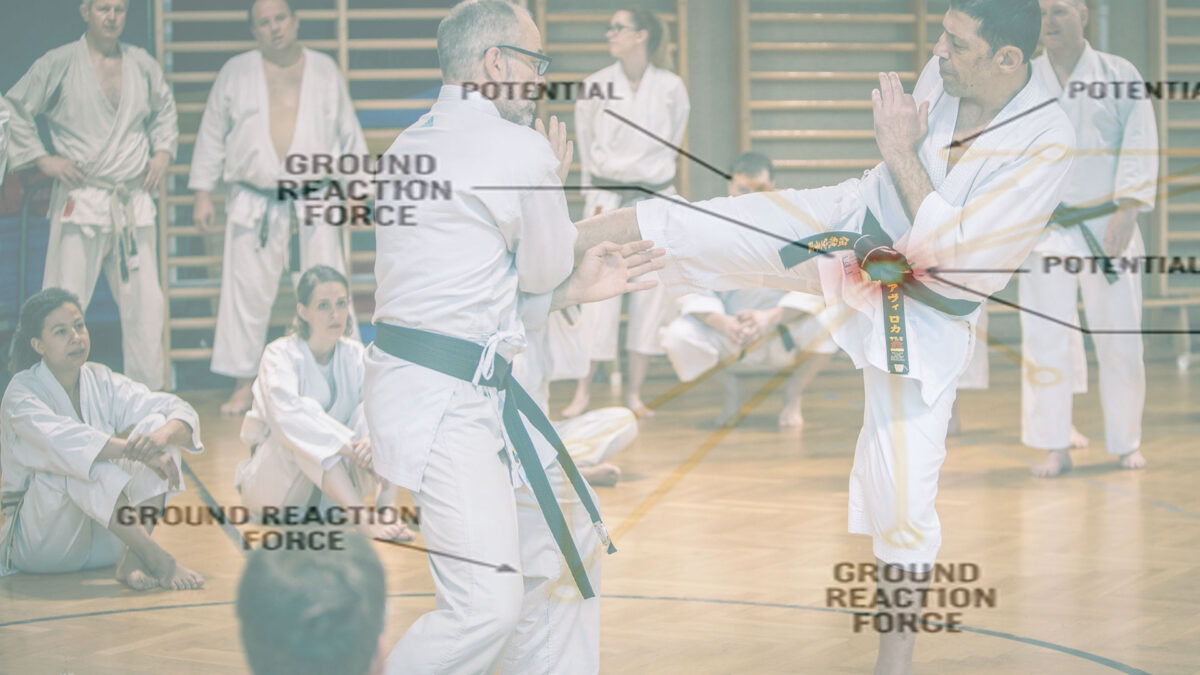
We begin with potential energy — the loaded state of the body, the pressure stored through internal compression before movement begins. When we release that compression into movement, we convert it to kinetic energy, the energy of body mass in motion. The effectiveness of the strike then depends on how that energy transitions into impact force. Force is what creates the effect required for todome. While energy can be shifted and recycled, force at the moment of impact always follows a specific vector. The body acts as a structural conduit directing the ground’s reaction toward the target. If the joints are not aligned, the force built from the ground leaks into your own structure. To achieve todome, the kinetic chain must be solid at impact, ensuring force travels through a pressurized, unified body.
Nishiyama Sensei’s Coach’s Manual organizes this into three interdependent layers: the source of power, its transmission through the body, and its focus at impact. Each layer depends on the one before it. And the first layer — the most fundamental one — is not physical at all.
The mental layer
Nishiyama Sensei was direct about this: “The most fundamental, and most important source of karate power, is mental.”
This is the first of the three interdependent layers — and without it, the other two cannot function to their potential. The claim is structural. Physical power is generated through the controlled contraction and expansion of muscle groups, and through the six body dynamics — vibration, rotation, shifting, rising, dropping, and pendulum — that produce force through technique. But all of this is controlled by the mental faculties. Without the mental layer operating correctly, the physical mechanisms cannot function to their potential.
What does the mental layer require? Nishiyama Sensei specified three conditions: stable emotions, a calm physical state, and control of ki — the individual’s mental energy, the internal charge that is the source of real power, channelled from the internal state to the external target.
Stable emotions matter because tension in the mind produces tension in the body. A student who is anxious, angry, or distracted cannot maintain the relaxed readiness that allows sudden, total body contraction. The surface muscles must stay soft for speed, while the deep muscles create the density needed for a strike. Mental agitation collapses this distinction — everything becomes either rigid or slack.
A calm physical state is the body’s expression of stable emotions. It is what Sensei Rokah calls mushin in application — fully present and uncommitted to any single outcome until the moment of action. From this state, the breath can trigger the technique without hesitation.
Ki as Nishiyama Sensei defines it is the directed mental energy that aligns the body unit toward the target. The eyes are the physical expression of this alignment. “The eyes guide the body” and “kime is from the eyes” — the eyes lock onto the target, establishing the line of action for the force vector. The mind provides the intent that initiates the first push. Without this, the body moves without direction, and force leaks in every direction but the intended one.
Sensei Rokah distils this: “Think by heart, act by ki.” The conscious analytical mind steps back. The body, trained and structured, acts through breath and intent rather than deliberation.
The two pushes and the floor
“Karate is the art of using the floor.” Nishiyama Sensei repeated this throughout his teaching. It is the most compact statement of the methodology’s physical foundation.
The floor is not passive. The floor responds to every push with equal force in return — the ground reaction that is the foundation of every technique. The question is whether your body is structured to receive that reaction and direct it toward the target, or whether it dissipates into loose joints and unaligned segments.
Nishiyama Sensei’s Coach’s Manual is precise: keep body contact to the floor or any surface from which continuous pushing or twisting action is generated, and maintain pressure to the floor through the entire delivery until completion of the technique. The connection to the floor exists throughout — it is the condition under which the technique exists from beginning to end.
Sensei Rokah explains the process through what he calls the two pushes. The first push is the initiation — the moment you engage with the floor to launch your centre of mass toward the target. This might be a drive from the back foot in a stepping technique, a rotation of the hips, or any movement that uses ground reaction to move the centre. Many students move without truly connecting to the floor, becoming light and losing power. Correctly executed, the first push sends the centre toward the target with the full weight of the body behind it — a release of stored potential energy through a structured, aligned body.
The second push occurs at impact. It is a sharp, strong pressure into the floor that roots the body into the ground at the exact moment of contact with the target. This is kime — total body contraction. By rooting at impact, the reaction from the opponent’s body travels through you into the floor rather than pushing you backward. In this moment, your effective mass includes the ground itself.
Coach’s Manual defines the result precisely: contact to the target is made via total body muscular contraction; loss of power is avoided by limiting recoil; transmission of power is directed forward, and through the target; impact shock power is increased by a very short focus time of total body power — 1/50th to 1/100th of a second. Without the second push, the technique is hollow. You will find yourself pushed away by the force of your own strike — bounced back by a target that has more effective mass than you in that moment. The technique scores nothing, delivers nothing, and achieves nothing that could qualify as todome.
The body as conduit
Understanding the two pushes is the starting point. The floor provides the force — the body must be structured to transmit it without leaking.
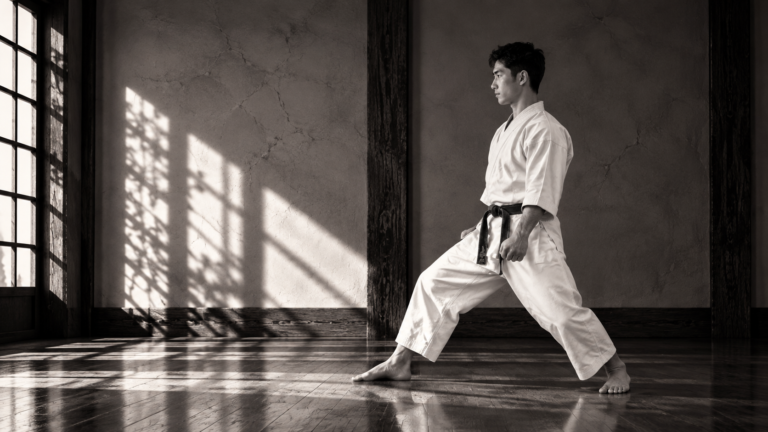
Stances are specific configurations of the legs and hips that serve two interdependent purposes: managing floor pressure while keeping the spine aligned and setting up the kinetic chain geometry through which ground reaction force travels to the target. Shifting — one of the six body dynamics — moves the centre of mass and serves both to establish the correct distance for the technique and, depending on the technique, to contribute directly to power generation through linear momentum. In some techniques, such as oi-zuki, shifting is a primary power source. In others, rotation is the main energy and shifting positions the body for it. The common error is attempting to apply both simultaneously — shift and technique at once — which splits the energy and weakens both.
The six body dynamics — vibration, rotation, shifting, rising, dropping, and pendulum — are the primary sources of power generation. Each technique in the system uses a specific combination of these dynamics determined by the geometry of the movement. In oi-zuki (lunge punch), for example, pure straight shifting is the primary dynamic — introducing rotation would split the energy line when what is needed is a straight vector. In mawashi-geri (roundhouse kick), rotation and the snap action from the knee generate the force. How that generated power is then transmitted to the target is answered by the kinetic chain — the sequenced movement of interdependent segments from the ground upward, each contributing to the total sum, none breaking the connection before impact.
The dynamics are only effective if internal pressure is maintained throughout. This is where Sensei Rokah’s metaphor of the water balloon becomes essential. By coordinating the breath with muscle contraction to create intra-abdominal pressure — IAP — we turn the trunk into a pressurised cylinder that does not buckle upon impact. The deep muscles of the lower back lock the ribs to the pelvis, creating a solid vertical axis. The breath does not inflate this system — it is expelled through the technique while the muscular contraction maintains the pressure. Any visible inhale mid-technique is kyo, a signal to the opponent and a momentary collapse of the internal structure. Without this vertical compression, the hips float, power leaks through a soft middle, and the kinetic chain is broken at its most critical link.
This pressurised trunk is also the medium that allows us to utilise the fascial spring — the network of connective tissue that wraps the body and acts like a high-tension elastic band. Fascia is most effective when pre-loaded. By maintaining expansion against the floor and moving from the centre, we keep this fascial network under tension. The mechanics of this system are explored in depth in The Continuous Web: Understanding Fascial Training in Traditional Karate. The difference between a slack string and a tuned guitar string is the tension. A pressurised body can go from a relaxed state to maximum force instantly, with no visible muscular wind-up. If internal pressure drops, the string goes slack, and kinetic energy is lost to heat and vibration within your own muscles rather than being delivered to the opponent.
The elbow is the clearest test of whether this system is working. Driving the arm forward with the shoulder muscles, disconnected from the core, produces a push. Sensei Rokah teaches that the arm must be plugged into the pressurised trunk. The elbow is a passenger on the centre. When the axis rotates or shifts, the weapon moves because the unit moves. If the arm moves independently, the connection to the floor is broken, and whatever force has been built from the ground is lost at the final link in the chain.
Watch Sensei Rokah’s demonstration of the body-elbow connection: https://www.youtube.com/watch?v=QZYRHbv2ZDE. Observe how the elbow must be carried by the centre. Note the “elbow down” cue — this ensures the shoulder stays down and the force vector stays directed through the pressurised centre rather than leaking upward.
From mechanics to mastery
Understanding the mechanics and applying them correctly in kihon and kata is the foundation. Precision becomes power when all layers operate as a continuous, unbroken unit.
In advanced practice, the end of one movement becomes the start of the next. The second push of a block — which roots you to the floor and stores energy in the fascial spring — must instantly become the first push of the counterattack. The energy is redirected, never discarded. The Coach’s Manual is explicit: each step in the sequence increases the ultimate power of the completed technique, but the timing of the individual segments into a complete whole is critical. If you reset between techniques — if you lose your connection to the floor between one action and the next — you have surrendered both the momentum of the encounter and the stored energy of your own structure. This is kyo, a hollow moment the opponent can exploit.
Zanshin — continuous awareness — is the mental expression of this physical continuity. The mind maintains the connection between techniques just as the body does. There is no moment of disengagement, no point at which attention relaxes and the internal pressure drops.
In kumite, we find out whether these principles actually live within us when the target is moving and fighting back. The mechanics do not change under pressure; they simply have to be applied faster and more precisely, through ukimi — the feeling of suspending the legs from the pressurised centre — to stay mobile. This keeps the feet light for movement while the centre remains heavy with potential energy. We do not walk; we glide, maintaining floor connection even while shifting. At any moment, a first push can happen.
Distance is space and pressure simultaneously. Even standing still, the expansion created by internal pressure and ground connection should be felt by the opponent. This is the physical reality behind ma-ai — the living interval is not neutral space but charged territory. The concept is explored fully in Ma-ai — The Space Between: The Rhythm of Distance in Traditional Karate. When you strike, you use the centre to carry the floor pressure into the target. Watch Sensei Rokah demonstrate the interaction of rhythm and ground: https://www.youtube.com/watch?v=wUH6Hyk7Rts. Observe how the breath and internal pressure act as the switch for rhythm, and how the connection of the back foot to the floor is what allows the karateka to stay elastic and responsive.
Traditional karate is the study of how a human being connects to the ground — pressing the floor, aligning the body, delivering mass through a straight-line vector.
The floor cannot be argued with or fooled. When the mechanical precision required by this methodology becomes internalised through practice, technique begins to look effortless. Mastery in traditional karate as taught by Nishiyama Sensei is when Shoshin — Beginner’s Mind, also pronounced Nyuanshin — meets a body perfectly in tune with the ground. At that moment, the search for todome ends where it began: with a clear mind and a solid floor. The strike is no longer something you do. It is something the ground expresses through you.
References
Nishiyama, H. (1989). Traditional Karate Coach’s Manual. International Traditional Karate Federation.
Nishiyama, H., & Brown, R. C. (1991). Karate: The Art of Empty-Hand Fighting.
Sources of teachings
All passages and concepts from Sensei Avi Rokah’s writings are used with appreciation and come from his official blog: rokahkarate.com
© Andrzej Czyrka / nyuanshin.com
This article may be shared, reprinted, or quoted for non-commercial purposes provided the author is credited and a link to the original article at nyuanshin.com is included. Commercial use requires prior written permission.
Leave a Reply