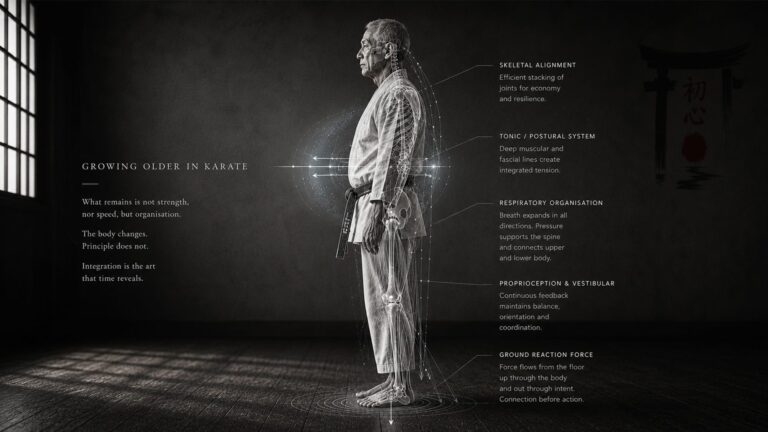
The Continuous Web: Understanding Fascial Training in Traditional Karate
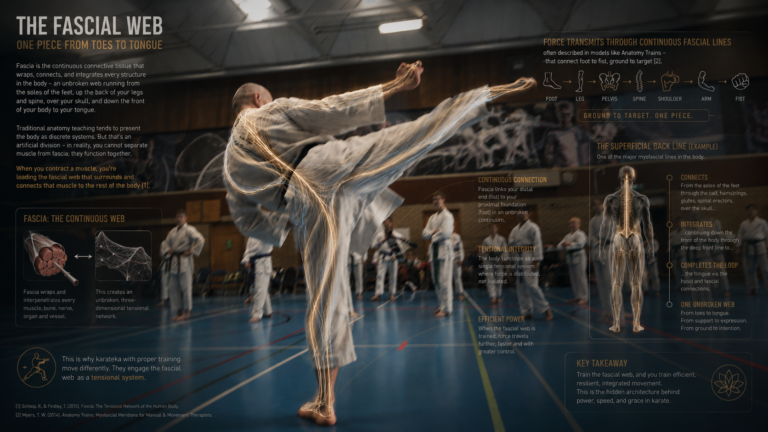
How traditional karate develops fascial qualities that modern training science is only beginning to understand and articulate.
…In some of my older students, weak scapular stabilizers – particularly the mid-back muscles (lower trapezius) and muscles along the ribs (serratus anterior) – created whole-body postural problems that (having read Radek’s article) I immediately connected to the stance work and centre of gravity topics Sensei Januš discusses…
The language of guesswork In the dojo, we often use terms like “power,” “force,” “speed,” and “strength” as if they mean the same thing, when they describe completely different physical phenomena. For anyone training in traditional karate as taught by Nishiyama Sensei and continued by Rokah Sensei, this vagueness creates real problems. Without understanding the…
Ma-ai — The Space Between This article reflects my personal understanding of traditional karate as taught by Sensei Hidetaka Nishiyama and transmitted by Sensei Avi Rokah. Any errors of interpretation are entirely my own. There are concepts in Japanese martial arts that resist translation — English simply has no equivalent for them. Ma-ai is one…